
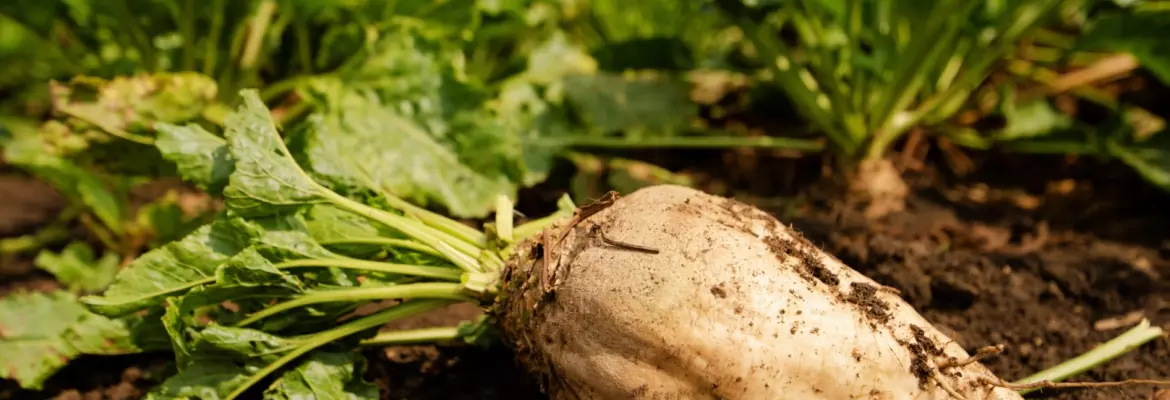
Sugar beet is a very demanding crop that does not like competition from weeds, especially during the early stages of growth, and until it covers the row.
It is a crop that requires several applications of chemical weedkiller and is very difficult to manage in an organic farming system. Nevertheless, mechanical weeding can be carried out from April to June. A pass with a row-crop cultivator, in good conditions, can easily replace the third chemical treatment, and ensure effective cropping management.
Problem weeds:
- Goosefoot
- Fumaria
- Mercuries
- Knotweed
- Ryegrass
Agronomic context and challenges
Crop rotation
Beetroot is a demanding crop that requires careful management and expertise. It has to be planted in a clean plot to avoid weeding difficulties later on. It is an excellent crop to have in a rotation because the deep root system (up to 1.5m) creates a good soil structure for the following crop, despite machine intervention, and its leaf residues are returned to the plot.
Reducing seed stocks with tillage
Careful soil preparation is a prerequisite for a successful beet crop. In cases of difficult grass weeds, ploughing can be very effective. However, the plough does not work well against dicots and should only be used occasionally in the rotation.
Deep stubble ploughing can be a good alternative to ploughing for destroying perennials and reducing seed stocks in the plot. Stale seeding, often used in organic farming, is less useful in conventional agriculture because it implies having to seed later, which is detrimental to yield. Nevertheless, it is a strategy worth considering in cases of serious weed infestation.
Comparing different weed-control strategies for beetroot
Satisfaction threshold
Source: ITB, Innovations agronomiques 81 (2020)
Possible treatment periods depending on mechanical weeding tools
| Crop stage | Pre-emergence | Emergence | 2 leaves | 4 – 8 leaves | 8 – 12 leaves | 12 leaves -80% ground cover | Weed stage |
|---|---|---|---|---|---|---|---|
| Rotary hoe | 🟢Pass possible 15 – 20 km/h | ⚠️Pass prohibited | ⚠️Pass prohibited | 🟠With care 10 – 12 km/h | ⚠️Pass prohibited | ⚠️Pass prohibited | White filament to 1st leaf |
| Tine weeder | 🟠With care 5 – 7 km/h Aggressiveness: ● | ⚠️Pass prohibited | ⚠️Pass prohibited | 🟢Pass possible 5 – 6 km/h Aggressiveness: ●●● | ⚠️Pass prohibited | ⚠️Pass prohibited | White filament to 3–4 leaves |
| Row-crop cultivator | ⚠️Pass prohibited | ⚠️Pass prohibited | 🟠With care 3 km/h with plant protectors. Depending on guidance equipment | 🟢Pass possible 5 km/h with finger weeder. Depending on guidance equipment | 🟢Pass possible 5 km/h with finger weeder. Depending on guidance equipment | 🟢Pass possible 10 - 12 km/h earthing-up. Depending on guidance equipment | 3 leaves and more |
Weed-control programmes for sugar beet
| Modality | Pre-emergence | Emergence | 2–3 leaves | 3–4 leaves | 6 leaves | 8 leaves | 10 leaves |
|---|---|---|---|---|---|---|---|
| BBCH | 0-9 | 10 | 11 | 13-14 | 14-15 | 15+ | |
| Option 1 All chemical | 🟢💦 | 🟢💦 | 🟢💦 | 🟢💦 | 🟢💦 | ||
| Option 2 Mixed, with row-crop cultivator | 🟢💦 | 🟢💦 | 🟢💦 | 🟢💦 | |||
| 🟢finger weeder | 🟠row-crop cultivator | ||||||
| Option 3 Mixed, with tine weeder | 🟢💦 | 🟢💦 | 🟢💦 | 🟠💦 | |||
| 🟢 ↘ | 1 - 2 passes 🟢row-crop cultivator | 1 - 2 passes 🟢row-crop cultivator | |||||
| Option 4 All mechanical | 🟠 ↘ | 🟢 ↘ or row crop cultivator | 🟢 ↘ | 3 passes 🟢finger weeder | 3 passes 🟢finger weeder | 🟢 row crop cultivator |
🟠optional 🟢essential 💦chemical ⚙️rotary hoe or ↘ tine weeder
Purely chemical
Beetroot is very sensitive to competition. It needs to be protected against weeds, from the seeding stage until it spreads out and covers the soil, i.e., about two months, depending on weather conditions.
Conventional strategies in terms of chemical weeding generally consist of four applications throughout the crop cycle. The first treatment is carried out at the cotyledon phase, and the other three are applied every two weeks until row closure.
Mixed strategy, with a row-crop cultivator
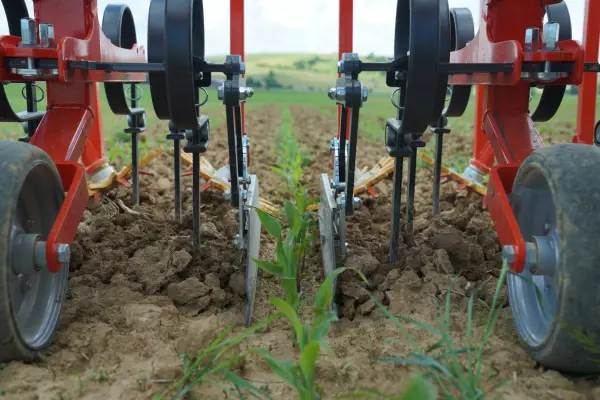
For beetroot, a pass well done with a row-crop cultivator can easily replace the third herbicide treatment. To get the best results, we recommend equipping the row-crop cultivator with fingers which work the row.
Mixed strategy, with a tine weeder
When the weed count is low, the first herbicide applicated can be postponed, and an intervention with a tine weeder can be carried out before the second herbicide. Row-crop cultivation before row closure acts as a safeguard in case the last chemical treatment does not work very well. Row-crop cultivation, before the summer, also has agronomic benefits.
Purely mechanical
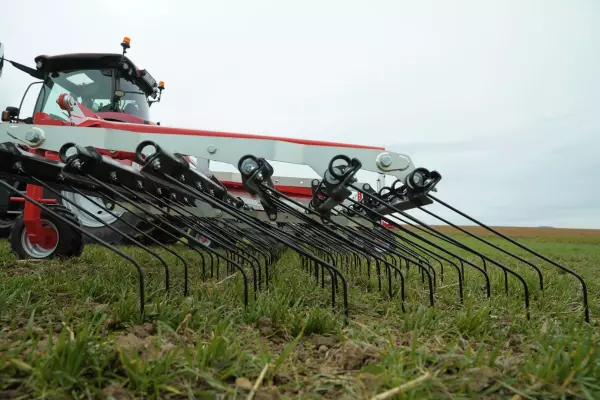
In organic agriculture, manual weed-control is generally necessary. The challenge is to limit the amount of manual weeding required by carrying out regular interventions with a tine weeder, rotary hoe, and row-crop cultivator. Tine weeding can be done at the pre-emergence stage, taking great care, and a first pass with a row-crop cultivator is possible from the 2-leaf stage.

Recommendations
Sugar beet is a very technical crop to grow, especially when it comes to weeding. In dry years, when herbicides are less effective, mechanical weeding can be a safe bet. It improves growing conditions by preserving moisture and helps control weeds before row closure.
Sources:
Combiner les solutions de désherbage pour limiter le recours aux phytos, ITB (Terres-Net), 2021
Désherbage : associer le mécanique au chimique, ITB, 2022
Le cahier technique, ITB, N°1108, 2020
Le désherbage mécanique en betteraves : c’est possible !, ITB, 2025
ITB, Innovation agronomiques 81 (2020)
Check out other articles on the same topic
- Combination strategies for weed control in legume crops
- Integrated weed-control strategies in sunflower
- Integrated weed‑control strategies in rapeseed
- Successful weed control in soybean combining herbicides and mechanical techniques
- Weed control for wheat fields and other autumn cereals
- Weeding in maize
- Weeding spring barley: combining herbicide and mechanical weed-control strategies