


For successful weed control in maize, opt for a combination strategy including herbicides and mechanical methods.
Adapting your weed-control strategy in maize: combining herbicides and mechanical weeding to combat weeds
Maize, the classic spring crop, is particularly well suited to mechanical weeding. Being sown in wide rows (50 to 80 cm), it is highly flexible in terms of weeding strategies, whether chemical or mechanical.
In dry years, when herbicides are less effective, row-crop cultivation is very effective. In addition to controlling weeds, it provides numerous agronomic benefits, such as preserving moisture in the soil and enhancing the mineral content of nutrients.
To ensure the success of mechanical weeding, however, it is essential to control perennials before planting the crop. Otherwise, row-crop cultivation can split the rhizomes, causing them to spread.
Problem weeds in maize:
- Ragweed
- Datura
- Bindweed
- Mercuries
- Summer grasses (panic grass, foxtail, crabgrass)
- Resistant ryegrass
- Knotweed
- Xanthium
What agronomic levers to implement as part of the weed-control strategy in crops?
A long intercrop period, several possibilities
The long period before planting maize gives you time to prepare the plot. Combining cover crops with successive stubble-cultivation operations before planting the crop can reduce seed stocks and perennials as well as improving the structure of the soil.
Stale seeding is a very popular technique with maize farmers. It is very effective in the right conditions. Indeed, it can reduce weeds by 60% when carried out at the end of March/beginning of April.
*Désherbage mixte, l’alliance du chimique avec le mécanique, Chambre d’agriculture des Hauts de France, 2022
Modifying the seeding date of maize can impact yield negatively. However, it is possible to delay it slightly to desynchronise weed emergence in order to kill them before seeding. With a maize crop, it is better to sow late rather than early.
Comparison of different weeding methods carried out by Arvalis at several different sites in France:
| Modality | Operation | Row Overall Flora Effectiveness | Inter‑row Overall Flora Effectiveness |
|---|---|---|---|
| All chemical | 1 post‑emergence (17 ref) | 6.3 | 6.5 |
| 2 post‑emergence (27 ref) | 7.8 | 7.8 | |
| 1 pre + 1 post (31 ref) | 8.0 | 8.0 | |
| Mixed in post‑emergence | 1 herbicide in post + 1–2 hoeing (34 ref) | 6.8 | 7.2 |
| 1 hoeing + 1 herbicide in post (9 ref) | 6.4 | 7.0 | |
| Mixed in pre + post | 1 herbicide in pre + 1–2 hoeing (27 ref) | 6.1 | 7.8 |
| 1 tine weeder in pre + herbicide in post (10 ref) | 7.0 | 6.8 | |
| All mechanical | 1 hoe in pre + herbicide in post + 1 hoeing (9 ref) | 1.9 | 6.4 |
| 1–2 hoeing (21 ref) | 2.0 | 6.5 |
- Acceptability threshold for effectiveness is at 7
- Pre-emergence = chemical application before maize emergence
- Post-emergence = chemical application between 2-leaves and 6-leaves stages
Possible treatment periods depending on mechanical weeding tools
| Crop stage | Pre-emergence | Emergence | 2 – 3 leaves | 3 – 4 leaves | 6 – 8 leaves | Weed stage |
|---|---|---|---|---|---|---|
| Rotary hoe | 🟢Pass possible 15 – 20 km/h | 🟠With care 10 km/h | 🟢Pass possible 12 – 15 km/h | 🟠With care 15 – 20 km/h | ⚠️Pass prohibited | White filament to 1st leaf |
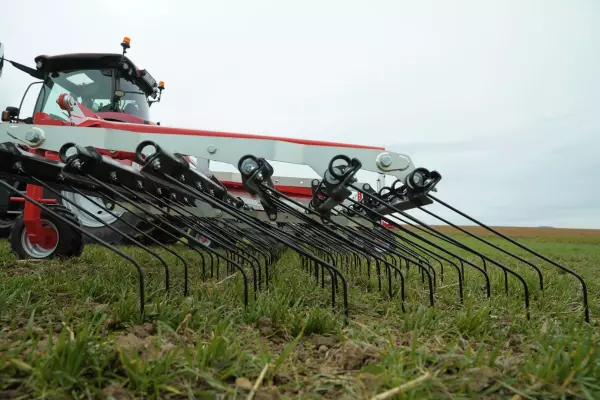
| Tine weeder | 🟢Pass possible 8 – 12 km/h Aggressiveness: ●●●● | ⚠️Pass prohibited | 🟠With care 3 – 5 km/h Aggressiveness: ●● | 🟢Pass possible 4 – 8 km/h Aggressiveness: ●●●● | 🟢Pass possible 4 – 8 km/h Aggressiveness: ●●●● | White filament to 3–4 leaves |
| Row-crop cultivator | ⚠️Pass prohibited | ⚠️Pass prohibited | 🟢Pass possible 2– 5 km/h with plant protectors | 🟢Pass possible 2– 5 km/h with plant protectors, earthing-up | 🟢Pass possible 2– 5 km/h with plant protectors, earthing-up | 3 leaves and more |
Weed-control programmes for maize
| Modality | Pre-emergence | Emergence | 2–3 leaves | 3–4 leaves | 6–8 leaves | Tractor pass limit |
|---|---|---|---|---|---|---|
| BBCH | 0-9 | 10-11 | 12-13 | 13-14 | 16-18 | 18 + |
| Option 1 All chemical | 🟢💦 | 🟠💦 | 🟠💦 | |||
| Option 2 Mixed, on faba beans | 🟢💦 | 🟠💦 | 🟠💦 | |||
| 🟢row-crop cultivator | 🟢row-crop cultivator | |||||
| Option 3 Mixed, on peas | 🟢💦 | |||||
| 🟢⚙️ or ↘ | 🟢⚙️ or ↘ | 🟠row-crop cultivator | 🟠row-crop cultivator | |||
| Option 4 All mechanical | 🟠⚙️ or ↘ | 🟢⚙️ or ↘ | 🟢⚙️ or ↘ | 2 passes 🟢row-crop cultivator | 2 passes 🟢row-crop cultivator |
🟠optional 🟢essential 💦chemical ⚙️rotary hoe or ↘ tine weeder
Purely chemical
There are several different ways of weeding maize. Pre-emergence root herbicides are the most effective against grasses (vulpine and ryegrass). A single application of pre-emergence herbicide may suffice to control weeds until harvest.
If it is not possible to treat the plot at the pre-emergence stage, alternative post-emergence solutions exist. The treatment is less effective on mature weeds, however, so it is better to take action early on.
In case of late weed emergence, treatment is possible up to the 8-leaf stage of the maize crop.
Mixed strategy, against difficult dicots and grasses
The pre-emergence / early post-emergence strategy is very effective against grasses and difficult dicots. To limit weed development before the summer, several passes with a row-crop cultivator are a good solution, even past the 6-leaf stage of the maize crop. Depending on conditions, a chemical product can be added as a complement.
Mixed strategy, with a tine weeder and a rotary hoe
When dealing with simple weed flora, chemical intervention can be delayed until the 3-leaf stage. Several mechanical interventions, using a tine weeder or rotary hoe, can be carried out pre-emergence, or post-emergence at the 2- to 3-leaf stage of the maize.
Purely mechanical
Repeated interventions with a rotary hoe, tine weeder, and row-crop cultivator make it possible to control weeds in maize without using herbicides, thereby reducing TFIs.
The organic trick for successful row-crop cultivation
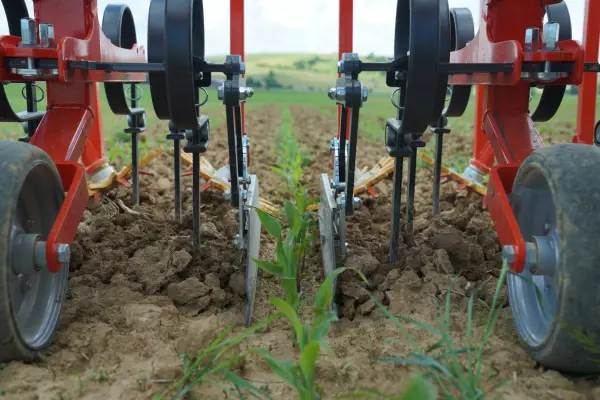
Maize does not like being covered with soil, so it is necessary to go carefully with the first row-crop-cultivation interventions (reduced speed, plant protector). However, it is beneficial to create a ridge before row closure: it stimulates the roots and buries the weeds in the row. To ensure effective results, it is essential to set the row-crop cultivator accurately.
Row-crop cultivators with fingers intensify the effect thanks to the supplementary action in the row.
Sources:
Blind Cultivation for Early-Season Weed Control in Organic Grains, Fact sheet series 22-2, Ograin (University of Wisconsin-Madison, 2023
Désherbage du maïs : quelles stratégies envisager ?, Arvalis, 2024
Désherber mécaniquement les grandes cultures, ITAB, 2012