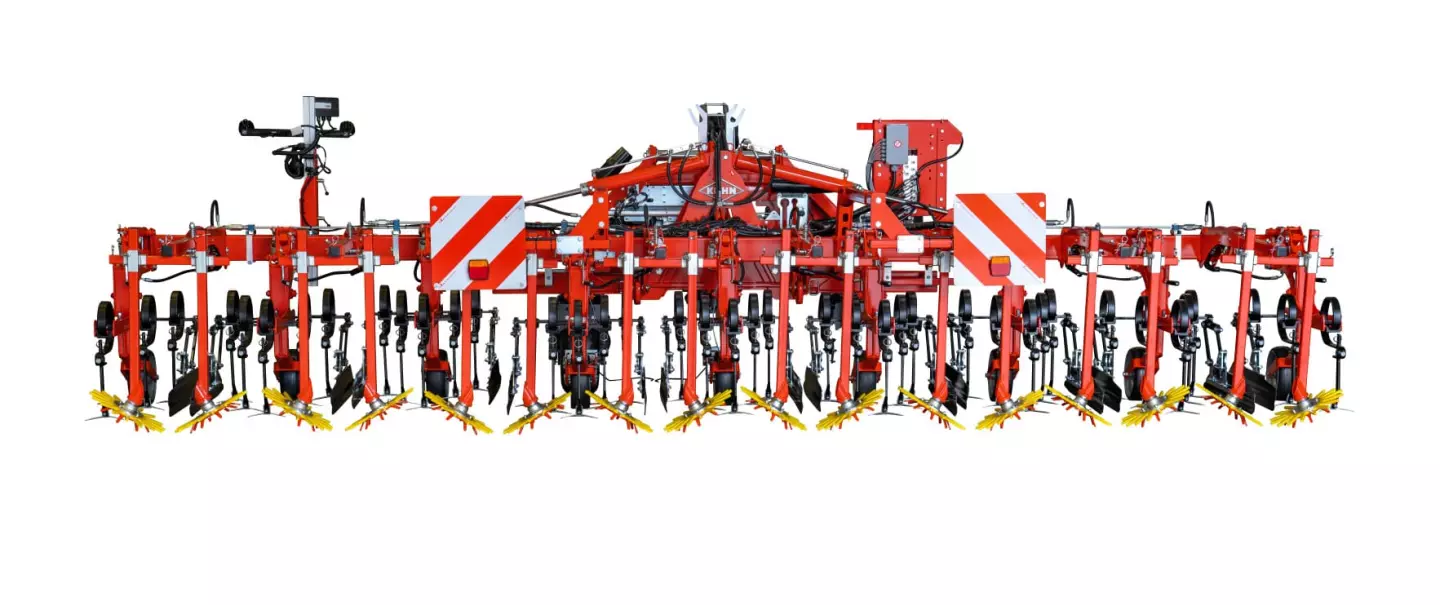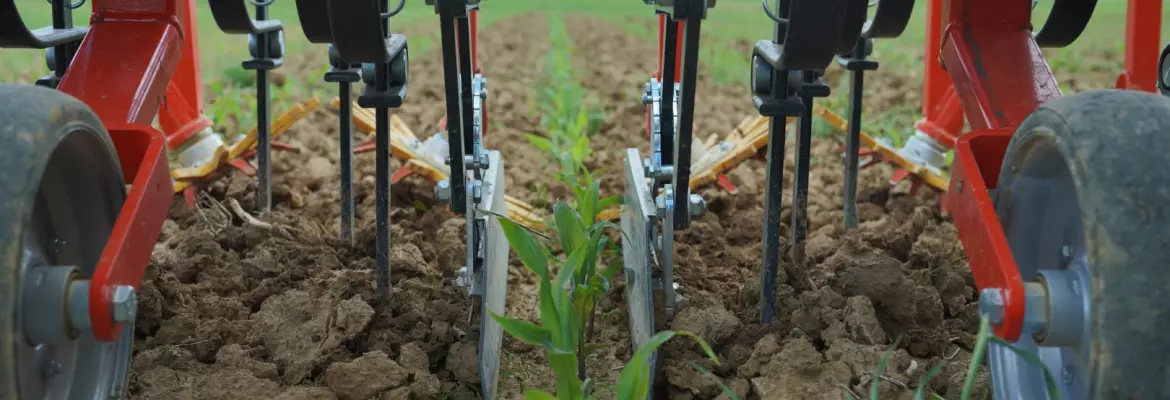
Long-neglected in favour of chemical weed control, row-crop cultivation is now regaining popularity in agricultural practices. In addition to controlling weeds mechanically, it provides numerous benefits in terms of making the soil healthier and more fertile, and the crop more vigorous.
Definition of row-crop cultivation
Row-crop cultivation is a mechanical weeding technique that consists of scalping the surface of the soil between rows of crops using a row-crop cultivator. It provides many benefits, particularly:
- Destroying weeds by scalping or covering them with soil.
- Aerating the soil around the crops, resulting in multiple agronomic advantages (humidity preservation, aeration, etc.).
Row-crop cultivation works well due to the destruction of weeds between rows before they start competing with the crop. It is a useful alternative to chemical weeding, both in organic and conventional farming.
Row-crop cultivation as a sustainable weed-control strategy
Row-crop cultivation is a key and sustainable strategy against weeds. As a mechanical weeding method, it is a useful alternative to herbicides and improves the resilience and sustainability of the cropping system. The method works well for:
- Fighting resistant weeds, such as autumn grasses (ryegrass, vulpine).
- Increasing the efficiency of herbicides as part of a mixed weed-control strategy, especially for crops such as sunflower and soya that do not have sufficiently effective chemical solutions in cases of major weed infestation.
- Replacing herbicides and reducing the TFI in cases of milder weed infestations.
Some tools, such as the row-crop cultivator with fingers, can weed the row around the base of the crop where a row-crop cultivator cannot usually go. A mound can also be created around the crop to bury the weeds that have not been uprooted.
Agronomic benefits of mechanical weed control
Row-crop cultivation makes the soil much healthier. By breaking up slaking crusts, the row-crop cultivator improves air and water circulation, as well as the essential elements to root development. The row-crop cultivator also stimulates the mineralisation of organic matter, liberating essential nutrients that feed the crop and contribute to its development.
The row-crop cultivator breaks the capillary fibres in the soil preventing the water from rising to the surface between rows. Result: less moisture evaporation, more humidity retained in the soil. Water optimisation is precious, particularly towards the summer season.
To sum up, row-crop cultivation has a positive impact on the quality of the soil. It creates an environment conducive to crop development. A pass with a row-crop cultivator at the right time maximises the associated benefits.
Using a row-crop cultivator
Choose equipment adapted to your conditions
You can choose between different equipment for row-crop cultivation, so it is important to select the right configuration for your crops and soil type. There are several criteria to take into account when choosing a row-crop cultivator:
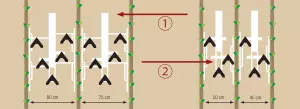
- The inter-row spacing used on the farm.
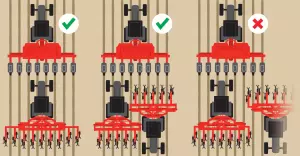
- The width of the precision seed drill used (width of row-crop cultivator = width of seed drill, or half width).
- The type of soil: Row-crop cultivators with fingers are suited to loose soils, for example. For heavy soils, it is more effective to create a ridge. You can work closer to the row with Lelièvres blades, but precision is necessary and the soil should be free of clods and stones.
You also need to determine the level of precision you require: The ROWLINK camera is a guidance system that enables you to work very close to the row, and to work faster, but it is an additional option to acquire. To keep production costs down, the RTK GPS guidance system may be sufficient, as long as the seeding operation was carried out with precision and you do not mind if row-crop cultivation is less precise.
Practices that optimise row-crop cultivation
To make row-crop cultivation as effective as possible, it is crucial to respect certain best practices. Timing is essential: row-crop cultivation is best carried out when weeds are young, at the seedling stage, because they are easier to destroy. In addition, it should be done before a dry period, so the weeds dry out on the surface of the soil and do not take root again.
Effectiveness of the row-crop cultivator depending on the stage of weed growth
White filament | Cotyledons | First leaf | Second leaf | Third leaf | Five Leaves | 5 to 10 cm | Seed formation |
|---|---|---|---|---|---|---|---|
| 🟢Easy to remove | 🟢Easy to remove | 🟢Easy to remove | 🟢Easy to remove | 🟢Easy to remove | 🟢Easy to remove | 🟠Resistant | 🔴Tough |
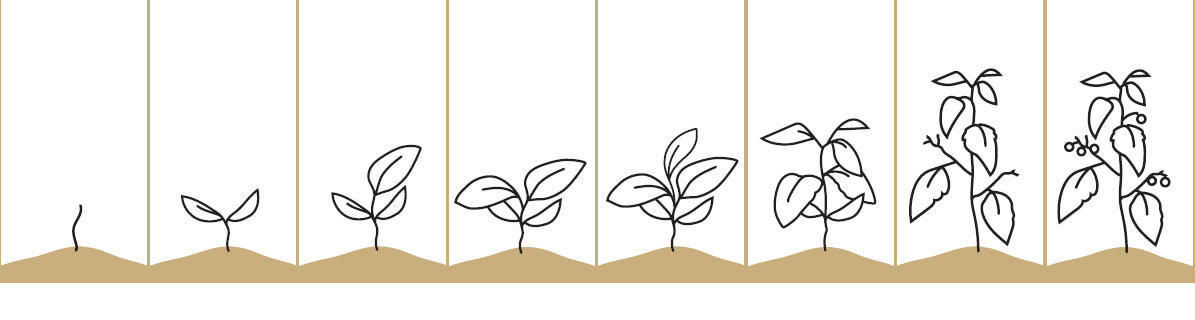
Source: The hoe, Terres Inovia, 2023
Stage of pass in the crop
| Post-sowing pre-emergence | Post-sowing germinated | Stem | colyledons | 1st unifoliate leaf | 1st trifoliate leaf | Hight 10 to 25 cm | Hight 25 to 50 cm |
|---|---|---|---|---|---|---|---|
| ⚠️Pass prohibited | ⚠️Pass prohibited | ⚠️Pass prohibited | ⚠️Pass prohibited | 🟠With care Speed: 3 km/h if plant protectors | 🟠With care Speed: 5 km/h | 🟢Pass possible Speed: 6 km/h | 🟢Pass possible Speed: 7-8 km/h |
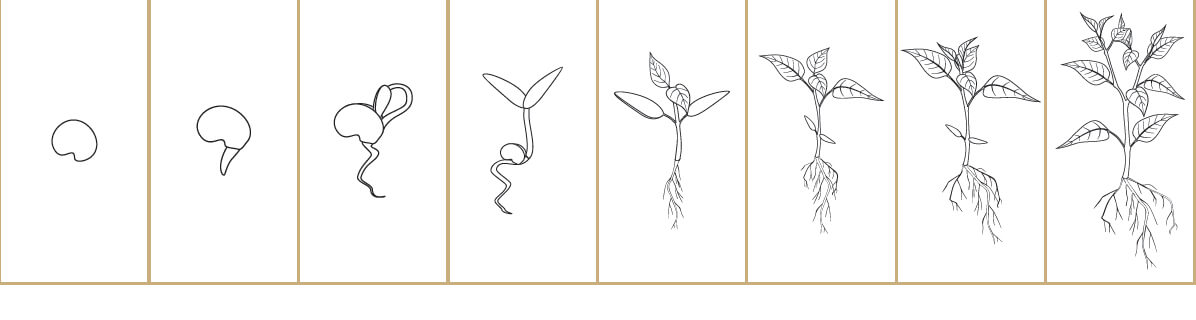
Source : Mechanical weeding of large crops, ITAB, 2012
It is also essential to set the machine correctly: Working-depth and plant-protector systems should be adjusted to suit the type of soil and stage of crop growth. Tractor speed should also be adapted in order to work with precision and avoid damaging the crop.
Row-crop cultivation can be further optimised by carrying out a pass with a tine weeder. After the row-crop-cultivation operation, the seeds are grouped together on the surface of the plot.