Tedders

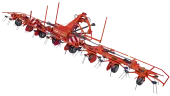
Tedding is an important stage in the forage harvesting process because it speeds up drying. Tedding aims to preserve the energy value of the forage and limit any weather risk. KUHN tedders are designed to ensure the best forage distribution in all situations, quickly and evenly. With working widths from 4.20 m to 17.80 m, there is a KUHN tedder to suit your needs.

Mounted Tedders

The tedding stage is essential within the harvest chain because it significantly contributes to speeding up fodder drying. Its goal is to preserve the energy value of the fodder while reducing the potential risks linked to weather conditions. The tedders are specially designed to ensure optimal forage distribution in all situations, thus promoting rapid and uniform drying. KUHN mounted tedders stand out for their versatility and great manoeuvrability, making them suitable for various crops and types of terrain. With a range of working widths extending from 4.20 metres to 13.00 metres, you are sure to find a KUHN tedder that perfectly meets your needs.

Read more

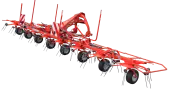
    • GF 502 machine silhouette

      GF 102

      4 simple and effective models from 4.22 m to 6.40 m.

    • The GF 1003

      GF 1003

      A range of 7 mounted tedders with working widths from 5.20 m to 10.80 m.

    • GF 8700

      Ted with a 8.70 m working width adapted for small-size tractors

    • The shape of the GF 13003

      GF 13003

      The mounted tedder with a 13 m working width

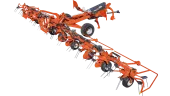
Trailed Tedders

Tedding represents an important step within the harvest chain, as it has a significant impact by speeding up the drying process. The objective is to preserve the energy value of the fodder while minimizing the risks linked to weather conditions. The tedders are designed to ensure optimal forage distribution, whatever the circumstances, thus promoting rapid and uniform drying. KUHN trailed tedders allow working large areas and benefiting from a large working width. With working widths ranging from 7.80 metres to 17.20 metres, you are sure to find a KUHN tedder that perfectly meets your needs.

Read more

Preserving High Quality Forage: The Role of the Tedder

The most cost-effective forage drying process available, this operation works by turning and spreading mown material evenly to retain nutritional value and encourage moisture loss. Moisture levels fall naturally under the sun, ensuring the best possible results for hay and forage producers across all grassland farming systems. After mowing, careful management of each pass plays a crucial role in the overall harvesting chain.

The number of passes required will depend on several factors: humidity levels, whether the mower has a conditioner, and the intended method of storage. Whether making hay or producing silage, a first pass is generally recommended directly after mowing, while moisture is still high, to limit leaf loss and begin rapid exposure to the sun. This considerably reduces overall curing time and improves palatability and digestibility of the finished crop.

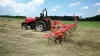
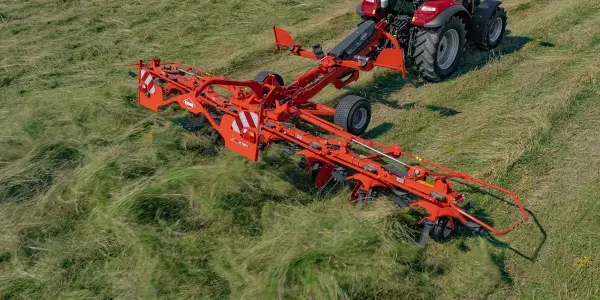
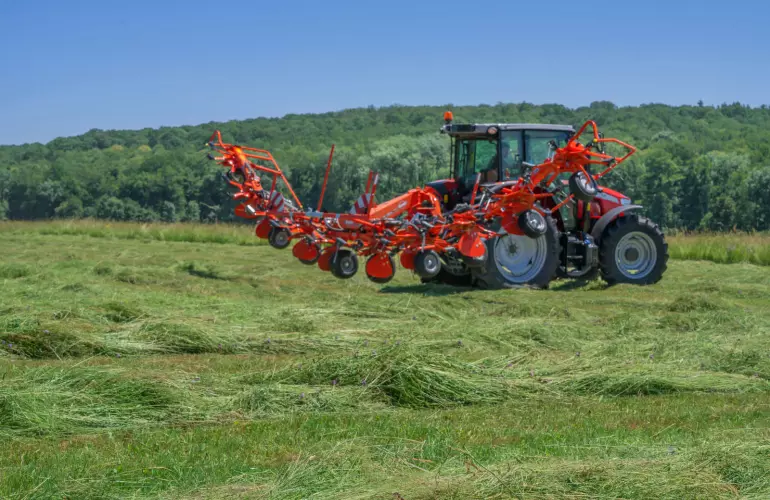
GF13003 Tedder Working - Ground Photo

A Tedder to Suit Every Need

KUHN offers a full range of hay tedders designed to meet the demands of all farm sizes and field conditions. From a compact entry-level machine for smaller plots through to wide-working models for large-scale operations, the KUHN agricultural machinery range includes mounted, semi-mounted, and trailed configurations to match different setups. Folding working width options are available across the range, keeping transport widths within legal limits and making movement between fields straightforward.

Choosing the Right Hay Tedder

The main differences between tedders concern the number of working heads, hitching system, working width, and compatibility with the swaths produced by the mower. Selecting the correct working width ensures the machine covers the full cut width for even distribution and thorough aeration. Output per hour of harvesting time is also influenced by machine size and configuration. Trailed models offer greater stability for larger operations, while the mounted version suits situations where headland space or power is limited.

Does Rotor Size Matter?

Size has a direct impact on how quickly cut material cures, due to differences in how it is turned and distributed.

Tedders with small rotors (diameter less than 1.50 m) produce an optimised spreading pattern, picking up all the cut material and distributing it evenly across the working width. The rotary action means fodder is projected high and wide, creating a more uniform result with fewer clumps. The gentle forage transfer minimises soil pick-up and preserves nutritional value.

Tedders fitted with large rotors (diameter more than 1.50 m) are better suited to very long or stemmy crops. The wider reach handles bulky material more effectively without blockages, maintaining consistent tine engagement across the full working width.

What is the power requirement?

For effective operation, power requirements vary depending on machine size and whether it is mounted or trailed. Semi-mounted models work well with low to medium power tractors and offer excellent field stability. At KUHN, requirements range from 30 to 140 hp, depending on model, ensuring a match for virtually any machine in the fleet. Selecting the right model for available horsepower keeps harvesting efficient and fuel consumption in check.

Tedder settings

The most important adjustments on a tedder are tine angle and working height.

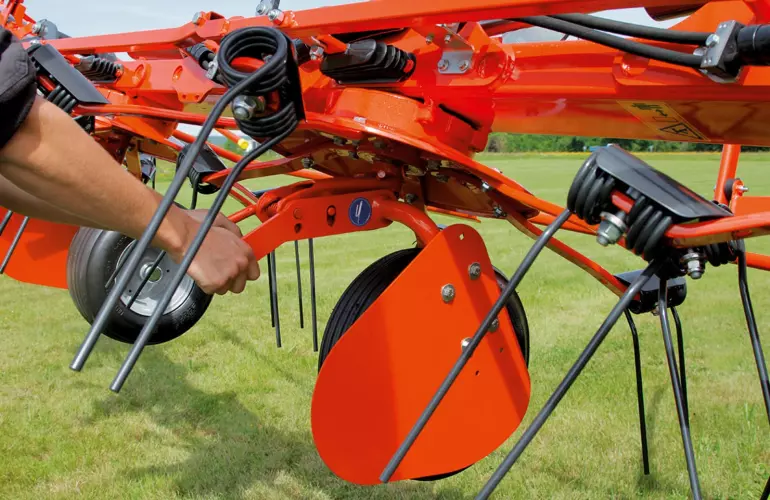
The angle determines how fodder is turned and thrown, directly influencing the spread width and the crop's exposure to the sun. A lever beneath each head allows this to be changed quickly: in the high position, it assists work in dense, heavy forage; in the low position, it suits lighter or less abundant material. 

With very short weather windows, machine adjustment is crucial to the success of the fodder harvesting chain. A well-adjusted machine ensures a smooth harvest.

Height is adjusted via the top link or using a gauge wheel, where fitted. The aim is to brush just above the ground surface without digging in. A correctly set tine arm height limits soil and impurity pick-up, ensuring high-quality and maximising the value of every pass.

Tine Angle Adjustment Setting Example

Maintenance, Durability and Parts Support

Maintenance is fundamental to long-term machine performance and uptime.

KUHN has designed its range to make routine servicing as easy as possible: greasing points are kept to a minimum, and service intervals are less frequent on comparable machines. The DIGIDRIVE finger drive system delivers reliability with very little upkeep compared with conventional cardan systems. Each gearbox is lubricated for life, eliminating one of the most time-consuming tasks. Genuine KUHN spare parts are available to keep hay tedders running at peak performance throughout their working life, and tine replacement is quick and simple to minimise downtime during the busy season.

Innovations That Improve Forage Quality

KUHN continually invests in innovation and leading technology to deliver increased output and better quality of work across every operation. Here are some of the innovations:

The OPTITEDD rotor is built around a patented crop flow concept that minimises the distance between the wheel and the asymmetrical tines, giving it exceptional ground-following capability. This improved pick-up and reduces dirt contamination, a design engineered for consistent performance in the most intensive conditions. Deflectors on each tine prevent forage from rising up and winding around arms, eliminating added stress and preventing loss in the event of breakage. The result is increased output per pass and a cleaner, more uniform windrow on every field.

OPTITEDD

stabilising system combining powerful springs with hydraulic suspension protects the machine both at work and on the road, even at higher transport speeds. It delivers unmatched operator comfort and consistent machine performance across the working day.

The HLC (Headland Lift Control) function raises all working heads simultaneously at the press of a button, making the machine easier to manoeuvre at headlands and preventing it from passing over already tedded material. 

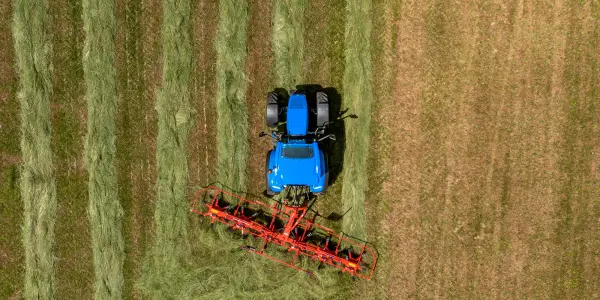
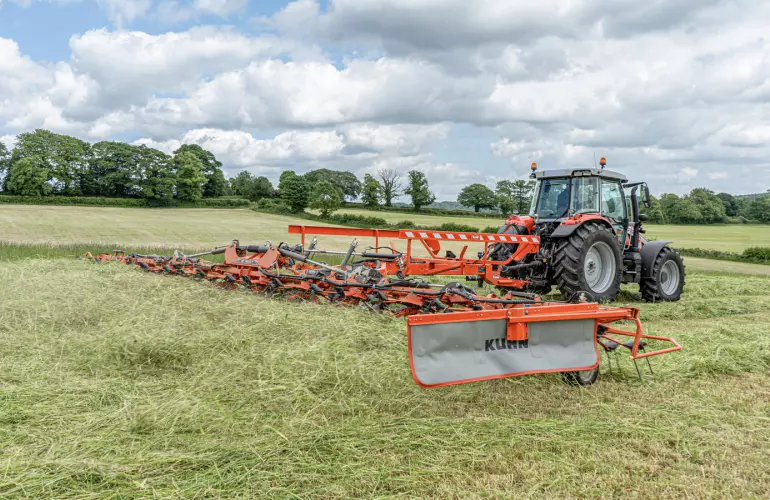
GF10803 Tedder Working - Ground Photo
dealer finder map KUK