Rakes & Mergers

KUHN's rake design is well adapted to harvesting and preserving the quality and nutritional value of the forage. KUHN offers solutions for collecting forage, whilst introducing minimal impurities. KUHN rakes, whether with rotors or belts, ensure reliability, maximum work output and uniform swaths.

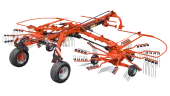
Single Rotor Rakes

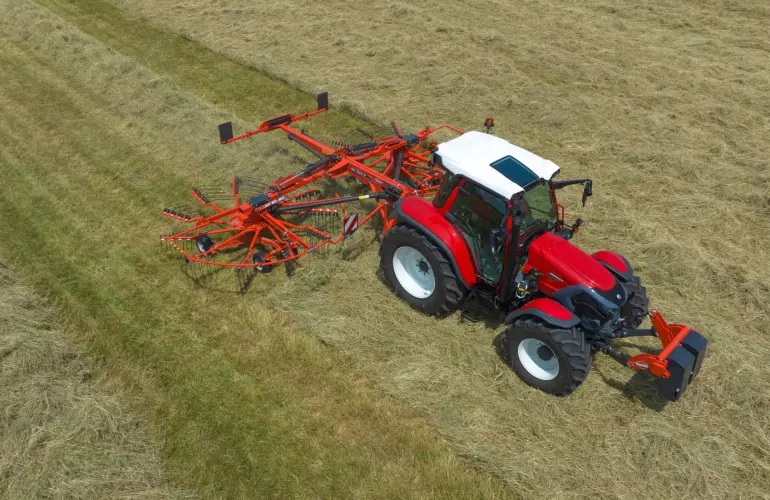
KUHN's rake design is well adapted to harvesting and preserving the quality and nutritional value of the forage. Single-rotor rakes are a simple and effective swathing solution. The KUHN range offers models in mounted or trailed versions, with working widths from 3.20 m to 5.00 m.

Read more

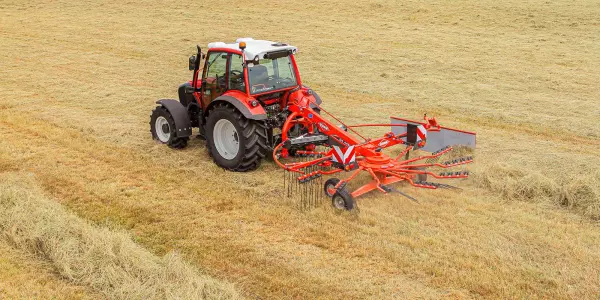
Twin Rotor Rakes

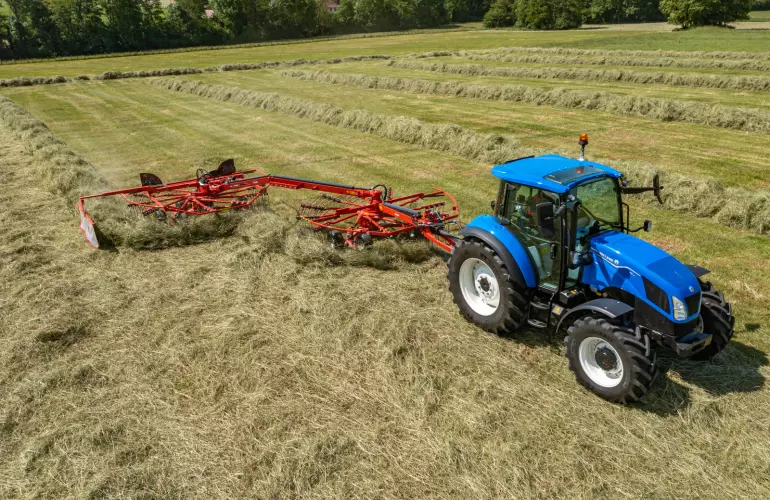
KUHN's rake design is well adapted to harvesting and preserving the quality and nutritional value of the forage. KUHN offers solutions for collecting forage, whilst introducing minimal impurities. The specific shape of the fork arms of KUHN rakes ensures a high work output, good swath formation and reliability. KUHN's twin rotor rakes are available in side or central delivery, with working widths between 5.40 m and 9.30 m.

Read more

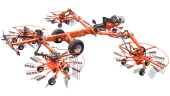
Four Rotors Rakes

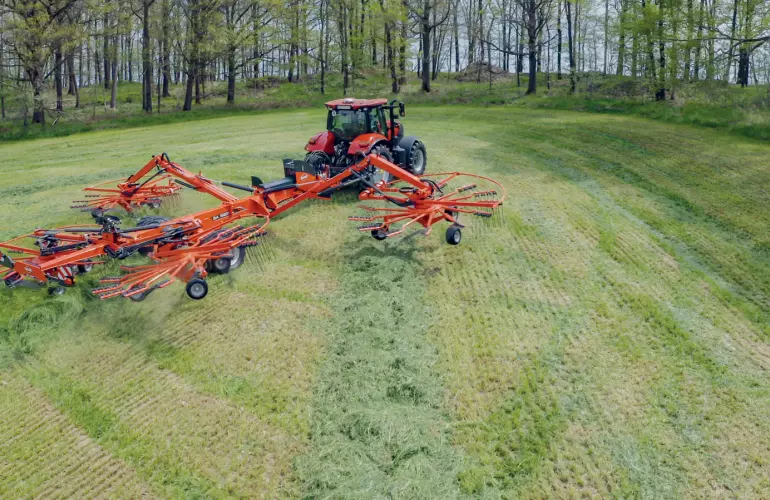
KUHN's rake design is well adapted to harvesting and preserving the quality and nutritional value of the forage. KUHN offers solutions for collecting forage, whilst introducing minimal impurities. KUHN's 4 rotor rakes offer a high work output, great performance and flexibility. KUHN's four-rotor rakes are available with working widths from 8.40 m to 14.70 m. The GA15131 set the world raking record with 188.9 hectares raked in 8 hours.

Read more

    • Silhouette of GA 10231

      GA 10231

      Make a difference with the hydraulic rotor drive!

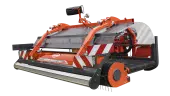
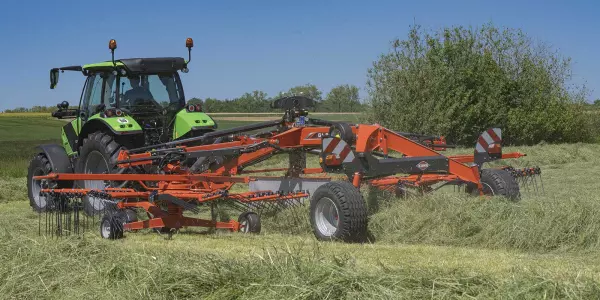
Belt Mergers

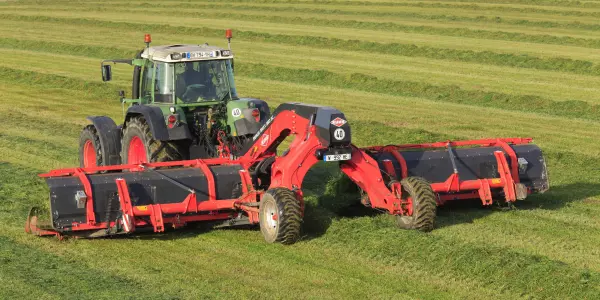
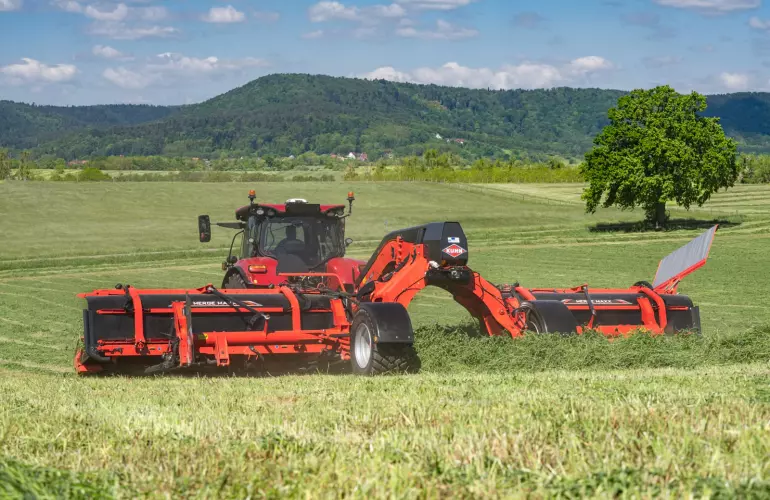
The MERGE MAXX belt merger is a super versatile machine. It has the unique ability to collect all types of forage in a gentle manor to maximise the preservation of the nutritional value, whilst minimising the introduction of impurities. The different swathing options will allow you to adapt the swath based on the volume of forage and the collection process. The MERGE MAXX offers swath widths from 7.50 m to 11 m in a single pass.

Read more

Tedder-Rake Combinations

Raking and tedding play a vital role in the grass harvesting process. Dry your hay faster and harvest sooner with KUHN's universal haymakers. Our tedder-rake combinations provide efficient, uniform spreading and a smooth performance over uneven ground. you can easily switch from tedder to rake in minutes, giving you maximum flexibility. With a wide range of working widths, we have the tedder-rake combination to meet your requirements.

Read more

    • HAYBOB tedder-rake combinations silhouette static view

      HAYBOB

      Tedder-rake combinations, working width 300 / 360 cm

Rakes and Mergers: The Windrow-Formation Stage

At the end of the harvesting chain, rakes gather the mowed crop to form regular windrows and swaths. Whether working with hay, silage, or wrapped bales, producing clean fodder with minimum soil and impurities is essential. Uniform, well-formed swaths make the work of balers, self-loading wagons, and forage harvesters far more efficient. KUHN's comprehensive product lineup is built to deliver exactly that.

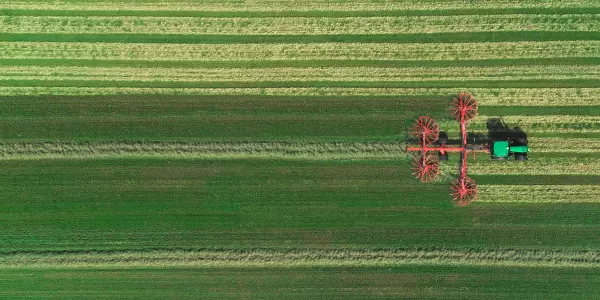
GA 15231 Four Rotor Rake Working on site - Aerial shot

Choosing the Right Rake or Merger

The right choice depends on several key factors: desired working width, available tractor power, forage type, crop volume, and operating intensity. Understanding the full range of equipment options for raking and merging is the first step to making the right decisions. Single rotary rakes are ideal for smaller operations or tighter fields, while standard twin rotor rakes are typically the go-to choice for medium-sized farms seeking a balance of output and simplicity. For larger volumes, multi-rotors and mergers offer maximum productivity. KUHN offers a highly diverse range of machines to meet the needs of all hay and forage producers, with mounted or trailed configurations available, and a front model also in the merger range. 

Rakes with rotors or belts?

As a pioneer in both rotary raking and merger technology, KUHN has built deep expertise across both product families.

Rotary rakes are typically designed so that tines are guided by rollers running in a cam track, gathering the forage and moving it into a clean swath to the side of the rotor. The engaging of the rake wheels in the crop is carefully timed to drive the rake wheels through the swath without soil disturbance.

GA7631 Twin Rotor Rake Working - Aerial Shot

Wheels are positioned as close as possible to the tines so the rotor follows ground contours precisely, ensuring consistent raking performance. The versatility and durability of KUHN rotary rakes are well established in the market.

GA7932+ Twin Rotor Rake Working - Aerial Shot

Belt mergers were originally developed for alfalfa dehydration plants, where preserving nutritional value and reducing leaf loss were the primary goals. Over time, these machines have been adapted for a wide range of forage harvesting applications. As farm sizes have grown, double and triple mergers have become available to cover larger working widths in a single pass, with merger pickup width configurations that allow precise matching to the harvesting equipment that follows. The pick-up collects the crop from the ground and transfers it onto a conveyor belt, which gently moves the forage to one or both sides of the machine, raking and merging swaths cleanly and efficiently.

Merge Maxx 952 Working - Ground Photo

This gentle handling preserves forage quality and minimises leaf loss, a critical factor for high-value crops. Mergers also offer flexible delivery options, producing either a single swath in the centre or delivering to the side, making them adaptable to a variety of field configurations.

What are the Maintenance Requirements of Rake Equipment?

With weather windows increasingly short, minimal downtime is essential during the harvesting season. KUHN has engineered its equipment to keep maintenance simple and fast.

Tines are fitted on the outside of the arms, which offers two advantages. First, they flex naturally to suit different forage types, extending their working life. Second, a broken time can be replaced individually without removing the other tines ahead of it on the arm, a genuine time saver during peak season.

The MASTERDRIVE gearbox, developed over 30 years ago, sets the benchmark for low-maintenance operation. Its fully sealed design means no oil changes are required. The two-stage concept reduces mechanical stress significantly, making it capable of handling intensive operations even in demanding conditions. Each tine arm is individually removable, making repairs straightforward.

MASTERDRIVE Gearboxes

On mergers and four-rotor rakes, the pick-ups, belts, and rotors are driven hydraulically. This eliminates the need for daily greasing of transmission components, further reducing routine maintenance time for operators.

Optimising Raking and Merging Performance 

A few straightforward adjustments help produce clean, uniform swaths that are easy for balers and forage harvesters to pick up: 

  • A moderate PTO speed ensures well-formed windrows and reduces fuel consumption. 
  • Adjusting windrow width allows operators to tailor the swath to match the intake width of the baler or harvester, ensuring smooth, consistent pickup and reducing the risk of crop losses. 
  • Adjusting raking height reduces the amount of soil, stones, and other impurities entering the swath, protecting forage quality and silage fermentation.

Innovations on KUHN Raking Equipment

KUHN continuously develops its rake and merger range to deliver higher performance, greater operator comfort, and reliability across the most intensive harvesting operations.

The unique double curved hyper-tangential arms lift at the precise moment of windrows formation, pushing forage efficiently to the outside of the rotor so tines disengage cleanly and quickly. The result is perfectly formed, uniform swaths, even when operating at high working speeds.

Twin-rotor models with side delivery feature the STABIDRIVE system, which ensures excellent stability during transport, headland turns, and manoeuvring on slopes, a key advantage for forage producers working on hilly ground. These machines cover ground quickly, making stability technology particularly important at high operating speeds.

On ISOBUS-equipped four-rotor rakes, the Section Control feature uses GPS to automatically raise and lower rotors at headlands and field corners. This reduces forage loss, prevents the rake from running over previously formed windrows, and significantly improves operator comfort by allowing drivers to focus on steering rather than manual rotor control.

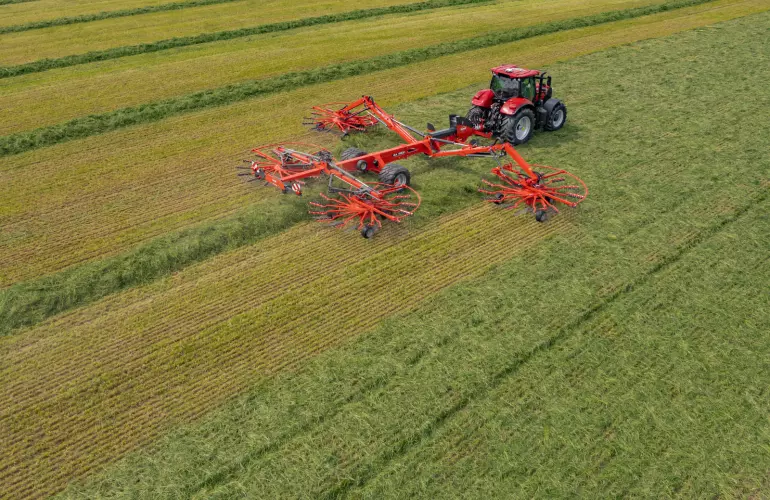
GA15231 Four Rotor Rake Working - Aerial Shot
dealer finder map KUK