
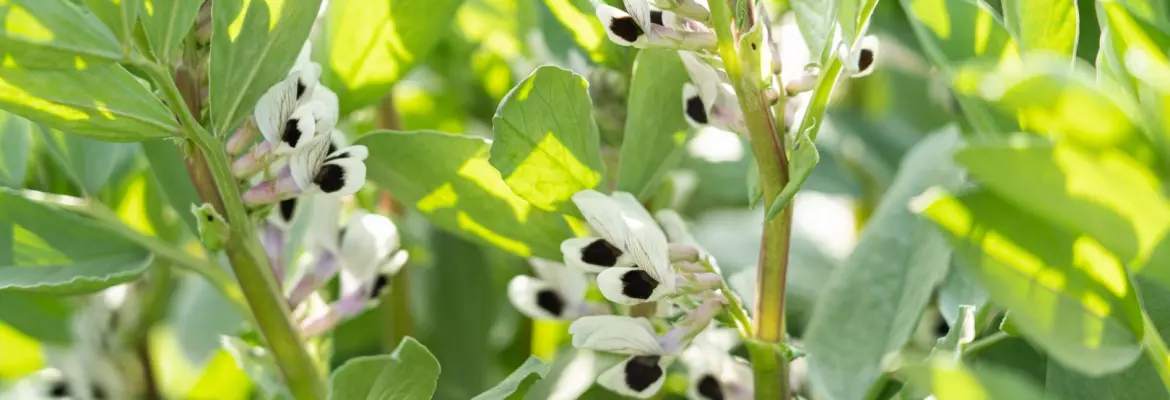
Legume crops such as field beans and peas are not very profitable in the short term, but are very beneficial in crop rotations. Their spring cycle breaks the cycle of winter grasses and reduces fungal problems. They also enrich the soil with nitrogen thanks to their atmospheric-nitrogen-fixing capacity, so they are great before a main crop.
In order to maximise the economic value of legumes, it is essential to manage costs carefully during the growing cycle. Alternatives to chemical weed control are, therefore, particularly relevant here.
Mechanical weeding works well in field beans, both pre- and post-emergence. It is more difficult with spring peas, though, as the tendrils wrap around the tools, limiting the possible weeding period to the 2-5 leaf stage.
For crops such as lentil, chickpea, and lupin, chemical solutions are limited. So mechanical weeding is a good technical option. In dry springs, it is even as effective as a purely chemical approach.
List of common problem weeds in legume crops:
- Ragweed
- Thistle
- Wild buckwheat
- Ragwort
- Sow thistle
- Grasses
Agronomic context and challenges
Plan weeding during the intercrop period
The long inter-crop period, before spring sowing, is a time with many possibilities. For instance, sowing cover crops is a great option for protecting the soil, limiting the loss of nitrogen, and storing carbon. Cover crops have to be destroyed sufficiently early, however, so as not to affect the preparation of the next seedbed.
Seeding early in spring ensures better yields. But this means that stale seeding and other agronomic practices are not adapted. The deep sowing depth of legumes, however, facilitates blind weeding, making it possible to destroy early dicot seedlings.
Possible treatment periods for field beans depending on mechanical weeding tools
| Crop stage | Pre-emergence | Emergence | 2 – 4 leaves | 4 – 6 leaves | After 6 leaves | Weed stage |
|---|---|---|---|---|---|---|
| Rotary hoe | 🟢Pass possible 10 – 12 km/h | ⚠️Pass prohibited | 🟢Pass possible 10 – 12 km/h | 🟢Pass possible > 15 km/h | ⚠️Pass prohibited | White filament to 1st leaf |
| Tine weeder | 🟢Pass possible 2 km/h Aggressiveness: ● | ⚠️Pass prohibited | 🟢Pass possible 2 km/h Aggressiveness: ●● | 🟢Pass possible < 10 km/h Aggressiveness: ●●● | ⚠️Pass prohibited | White filament to 3–4 leaves |
| Row-crop cultivator | ⚠️Pass prohibited | ⚠️Pass prohibited | 🟠With care 3 km/h with plant protectors According to guidance equipment | 🟢Pass possible 5 – 10 km/h with finger weeder, earthing-up. According to guidance equipment Pass prohibited in the presence of flowers | 3 leaves and more | |
Cost, work time, and TFI comparison of different weed-control strategies in field beans
| Modality | Pre-emergence | Post-emergence | TFI | Working time (min/ha) | Costs |
|---|---|---|---|---|---|
| Mixed Tine weeder | Aclonifen 900 g/ha + imazamox 32 g/ha, 500 g/ha pendimethalin | Tine weeder twice between 2 and 8 leaves | 0.8 | 22 | Mechanical weeding costs: 19 €/ha |
| Mixed rotary hoe | Aclonifen 900 g/ha + imazamox 32 g/ha, 500 g/ha pendimethalin | Rotary hoe twice from emergence to 3 leaves | 0.8 | 27.5 | |
| Chemical | Aclonifen 1200 g/ha + imazamox 50.1 g/ha, 750 g/ha pendimethalin | / | 1.2 | 7.5 | Chemical weeding costs |
Visual Effectiveness on Weeds (%)
| Modality | Type of year | Year | Effectiveness |
|---|---|---|---|
| Mixed Tine weeder | Normal | 2016 | 95% |
| Dry | 2017 | 97% | |
| Dry | 2018 | 86% | |
| Mixed rotary hoe | Normal | 2016 | 90% |
| Dry | 2017 | 99% | |
| Dry | 2018 | 76% | |
| Chemical | Normal | 2016 | 95% |
| Dry | 2017 | 90% | |
| Dry | 2018 | 57% |
Summary
- Mechanical methods (tine weeder and rotary hoe) show very high effectiveness, especially in normal and mildly dry years (90–99%).
- In very dry conditions (2018), effectiveness decreases but remains strong for mechanical methods (76–86%).
- Chemical control remains highly effective in normal and moderately dry years (90–95%) but drops significantly to 57% in very dry conditions.
Weed-control programmes for legume crops
| Modality | Post-sowing pre-emergence | Emergence | 2–4 leaves | 5–6 leaves | More than 6 leaves |
|---|---|---|---|---|---|
| BBCH | 0-9 | 10 | 12-14 | 14-16 | 16+ |
| Option 1 All chemical | 🟢💦 | 🟠💦 | |||
| Option 2 Mixed, on faba beans | 🟢💦 reduced dose | ||||
1–2 passes 🟢⚙️ or ↘ | 1–2 passes 🟢⚙️ or ↘ | ||||
| Option 3 Mixed, on peas | 🟢💦 | ||||
| 🟠⚙️ or ↘ | 1–2 passes 🟢⚙️ or ↘ | ||||
| Option 4 All mechanical | 🟠⚙️ or ↘ | 🟢⚙️ or ↘ | 1–2 passes 🟢row-crop cultivator |
🟠optional 🟢essential 💦chemical ⚙️rotary hoe or ↘ tine weeder
Recommendations
Spring legumes are crops that can sometimes have major weed issues that are difficult to control with chemical products due to the lack of available molecules. Therefore, combining chemical and mechanical weeding can be an effective solution, both economically and in terms of efficiency. It is also a more sustainable approach because diversification reduces resistances developing. On the other hand, the mixed approach is riskier.
Sources:
- Combiner les moyens pour désherber ses pois et féveroles de printemps, Terres Inovia, 2025
- Désherbage mécanique ou mixte de la féverole, Terres Inovia, 2023
- Guide de culture, féverole, Terres Inovia, 2024