
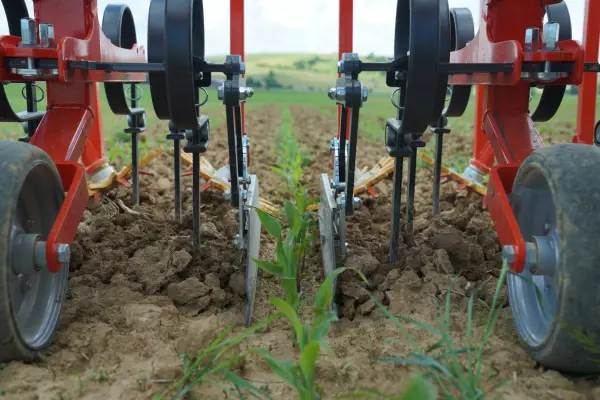
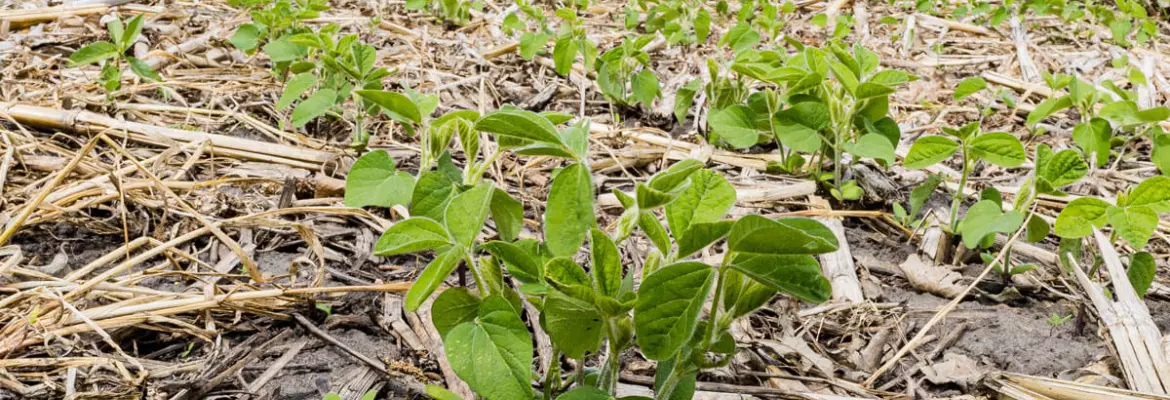
Soybean is a summer crop that is suited to mechanical weeding. The relatively low profitability of this crop means that alternative and more economical techniques need to be found.
The weeding strategy has to be effective during the first two months of growth. It is very important that certain species, such as nightshade (toxic), xanthium (stains soybean seeds), and datura (toxic and stains), are controlled for human consumption. As such, mechanical weeding can complement herbicide solutions for the most difficult weeds.
Problem weeds for soybean crop:
- Ragweed
- Thistle
- Hedge bindweed
- Wild buckwheat
- Summer grasses (Panic grass, foxtail, crabgrass)
Weeds highly regulated for human consumption:
- Jimson weeds
- Nightshade
- Xanthium
Agronomic context and challenges
Soybean offers valuable agronomic benefits thanks to its flexibility in crop rotations and its ability to fix atmospheric nitrogen, improving soil fertility for subsequent crops. Its planting window also aligns well with stale‑seedbed techniques, allowing multiple weed‑control operations before sowing. While soybean tolerates later planting dates, timing remains crucial to avoid water stress, especially for non‑irrigated fields, making careful management of seeding schedules an essential part of successful crop establishment.
Rotations
Soybean fits nicely between crops with different biological cycles. It just needs to be planted in plots with little risk of summer-crop weeds. Due to its very good capacity to fix atmospheric nitrogen in the soil, soybean returns a good share of its nutrients to the soil, which is great for the following crop. As such, it can be planted before a nitrogen-hungry crop to reduce input requirements.
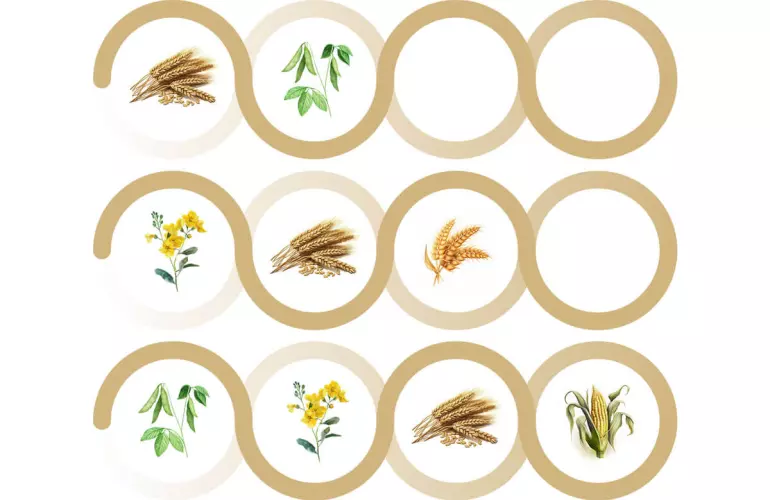
Stale seeding, delayed seeding date
As with sunflower, the planting period for soybean is conducive to stale seeding, which should be carried out quite early, depending on the soil type.
Soybean is well adapted to a later seeding date, which means that one or more stale-seeding operations can be carried out beforehand. It should not be planted too late though, as it could suffer from a shortage of water. Non-irrigated soybean can be sown up to May 15th, whereas irrigated soybean can be sown as late as May 25th, no problem.
Comparing different weed-control strategies for soybean
| Modality | 1️⃣Mecha TW | 2️⃣Mecha RH | 3️⃣Pre-emergence + HE post | 4️⃣Pre-emergence + HR post | 5️⃣Pre-emergence | 6️⃣Chemical ref |
|---|---|---|---|---|---|---|
| Pre-emergence | Tine weeder | Rotary hoe | Pendimethalin 800 g/ha | Pendimethalin 800 g/ha | Pendimethalin 800 g/ha | Pendimethalin 800 g/ha |
| Post-emergence from 1st leaf to 25 cm high | 1 to 2 tine weeder passes | 1 to 2 rotary hoe passes | 1 to 2 tine weeder passes | 1 to 2 rotary hoe passes | - | 2x imazamox 25 g/ha (at 2-3 leaves then 10 days later) |
Effectiveness of different cultivation methods on simple flora (annual mercury, black nightshade and white goosefoot):
Satisfaction threshold
Source: Weed management in soybean crop, Terres Inovia, 2020
Economic assessment of the different methods
| Workforce €/ha | |
| Mecha tools costs €/ha | |
| Spraying costs €/ha | |
| Herbicide costs €/ha |
Costs in €/ha
Working time min/ha
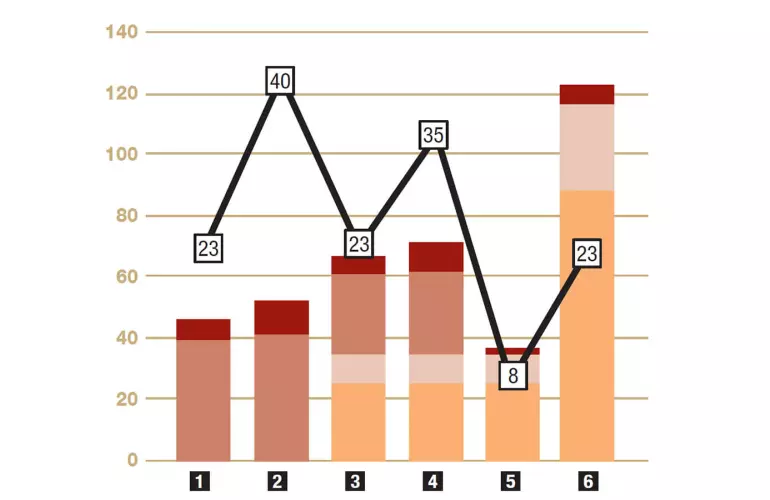
Hoeing strengthens herbicide performance in fields with complex weed pressure
Possible treatment periods depending on mechanical weeding tools
| Crop stage | Pre-emergence | Germinated | Stem | Spread cotyledons | 1st unifoliate leaf | 1st trifoliate leaf | Height 10 to 25 cm | Height 25 to 50 cm | Weed stage |
|---|---|---|---|---|---|---|---|---|---|
| Rotary hoe | 🟢Pass possible 15 – 20 km/h | 🟢Pass possible 15 – 20 km/h | ⚠️Pass prohibited | 🟠With care 10 km/h | 🟢Pass possible 10 – 15 km/h | 🟢Pass possible 10 – 15 km/h | 🟢Pass possible 10 – 15 km/h | ⚠️Pass prohibited | White filament to 1st leaf |
| Tine weeder | 🟢Pass possible 8 – 10 km/h Aggressiveness: ●●● | 🟢Pass possible 8 – 10 km/h Aggressiveness: ●●● | ⚠️Pass prohibited | 🟠With care 2 km/h Aggressiveness: ● | 🟢Pass possible 3 km/h Aggressiveness: ●● | Pass possible 4 – 5 km/h Aggressiveness: ●●● | Pass possible 6 – 7 km/h Aggressiveness: ●●● | ⚠️Pass prohibited | White filament to 3–4 leaves |
| Row-crop cultivator | ⚠️Pass prohibited | ⚠️Pass prohibited | ⚠️Pass prohibited | ⚠️Pass prohibited | 🟠With care 3 km/h with plant protectors. | 🟢Pass possible 5 km/h Depending on guidance equipment | 🟢Pass possible 6 km/h Depending on guidance equipment | 🟢Pass possible 7 - 8 km/h Depending on guidance equipment | 3 leaves and more |
Weed-control programmes for soybean
| Modality | Pre-emergence | Cotyledons | 1st unifoliate leaf | 3–4 true leaves | 4-5 leaves | Row-crop cultivator pass limit |
|---|---|---|---|---|---|---|
| BBCH | 0-9 | 10 | 11 | 13-14 | 14-15 | 15+ |
| Option 1 All chemical | 🟢💦 | 🟢💦 | ||||
| Option 2 Mixed, with row-crop cultivator | 🟢💦 | 🟠💦 | ||||
| 🟢⚙️ or ↘ | 1 - 2 passes 🟢row-crop cultivator | 1 - 2 passes 🟢row-crop cultivator | ||||
| Option 3 Mixed, without hoeing | 🟢💦 | |||||
| 🟠⚙️ or ↘ | 🟢⚙️ or ↘ | |||||
| Option 4 All mechanical | 🟠⚙️ or ↘ | 1 - 2 passes 🟢⚙️ or ↘ | 1 - 2 passes 🟢⚙️ or ↘ | 1 - 2 passes 🟢row-crop cultivator | 1 - 2 passes 🟢row-crop cultivator |
🟠optional 🟢essential 💦chemical ⚙️rotary hoe or ↘ tine weeder
Purely chemical
In general, two applications are necessary to weed soybean, combining a pre-emergence root herbicide, and a second herbicide, post-emergence. Different solutions are possible, mainly imazamox-based for post-emergence. The product should be adapted to the weeds on the plot.
Mixed strategy, with a row-crop cultivator
For soybean, a mixed weeding strategy is at least as effective as a purely chemical one. Combining a pre-emergence weed-control product with row-crop cultivation kills the new weed shoots (summer grasses, for instance).
Mixed strategy, with a tine weeder
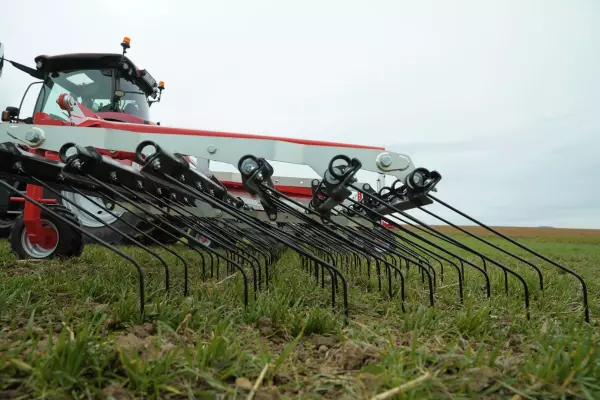
If it is not possible to use a row-crop cultivator, you can use a tine weeder or rotary hoe early in the cycle, to limit the growth of grasses like ryegrass, and then apply a chemical product later, post-emergence.
Purely mechanical
Without herbicides, it is important to sow soybean in rows so that you can pass with a row-crop cultivator at the end of the cycle. Grasses can prove difficult to manage. It is necessary to weed with the row-crop cultivator regularly during crop growth.

Recommendations
Just like sunflower, there can be a lack of chemical solutions to destroy difficult dicots in soybean. In addition, certain toxic weeds are subject to very strict controls for human food outlets, so mixed weeding methods can be a good solution for this crop.
Sources:
Blind Cultivation for Early-Season Weed Control in Organic Grains, Fact sheet series 22-2, Ograin (University of Wisconsin-Madison, 2023
Désherbage mécanique du soja, Terres Inovia, 2019
Gestion des adventices en soja, Terres Inovia, 2020
Stratégies herbicides pour désherber le soja, Terres Inovia, 2025
Check out other articles on the same topic
- Combination strategies for weed control in legume crops
- How to combine herbicides and mechanical weeding for sugar beet?
- Integrated weed-control strategies in sunflower
- Integrated weed‑control strategies in rapeseed
- Weed control for wheat fields and other autumn cereals
- Weeding in maize
- Weeding spring barley: combining herbicide and mechanical weed-control strategies