Mechanical weeding tools compared
Mechanical weeding is a method of eliminating weeds without using chemical products. There are several possibilities for mechanical weed control, so how do you choose between a row-crop cultivator, ti...

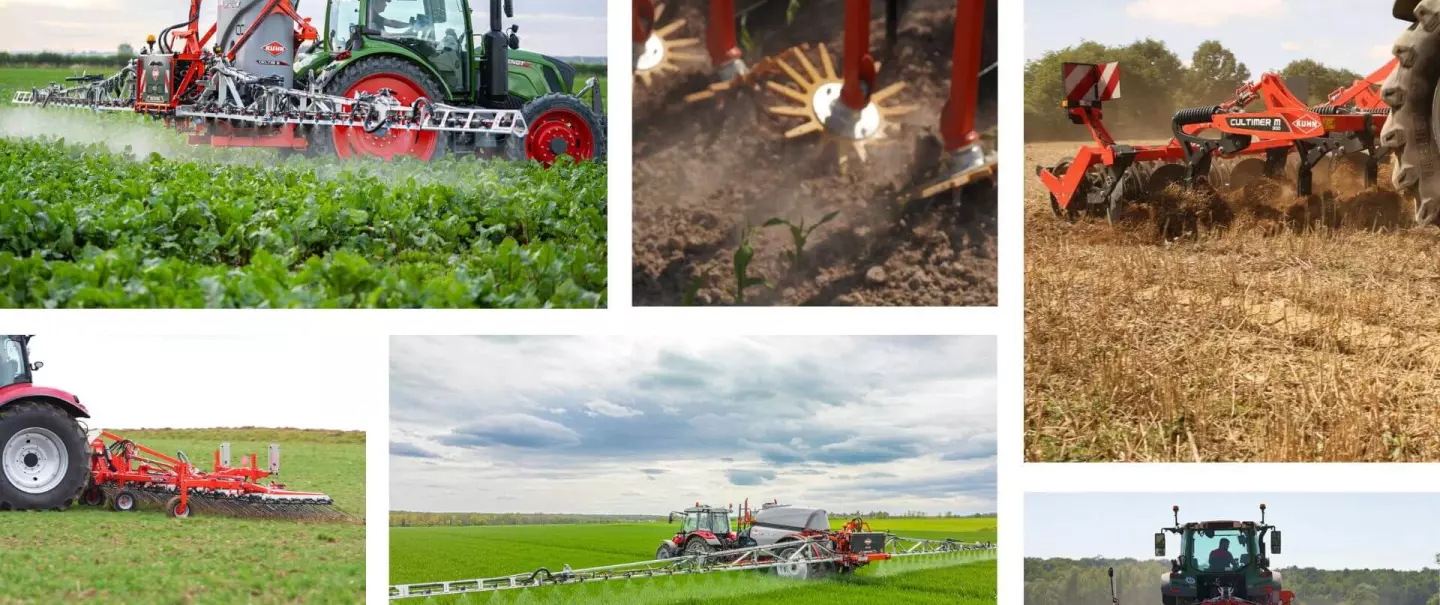
Modern weed control is evolving from a purely chemical approach to an integrated strategy that combines mechanical, chemical, and agronomic methods. This shift aims to reduce herbicide dependence, manage resistance, and promote sustainable farming practices.
Crop weeding is no longer limited to herbicides, rather, it is part of the production system strategy as a whole.
Crop diversification, intercropping, tillage, and even the choice of sowing date are all agronomic levers that can reduce weeds and should be prioritised over pesticides.
At the same time, mechanical weeding tools have greatly improved. They are more precise, more effective, and better suited to field conditions. They are a real alternative and a good complement to chemical weeding solutions
This change in practices marks a turning point: weed control is becoming a strategy in its own right, that requires new agronomic and technical approaches.
Combining mechanical and chemical methods in a mixed weed control strategy is becoming a valuable tool in the transition to more sustainable and low-input farming systems.
It is a reasoned approach that makes it possible to reduce herbicide inputs while remaining highly effective against weeds. In addition, it is easier to manage resistance to herbicides and to adapt operations to weather conditions. By using different techniques, the effect of the substances still available is prolonged. Indeed, combined weed control becomes a real response to current and future challenges.
With nearly 200 years of experience, we have the expertise to offer you two complementary solutions—mechanical weeding and spraying—for a comprehensive strategy.
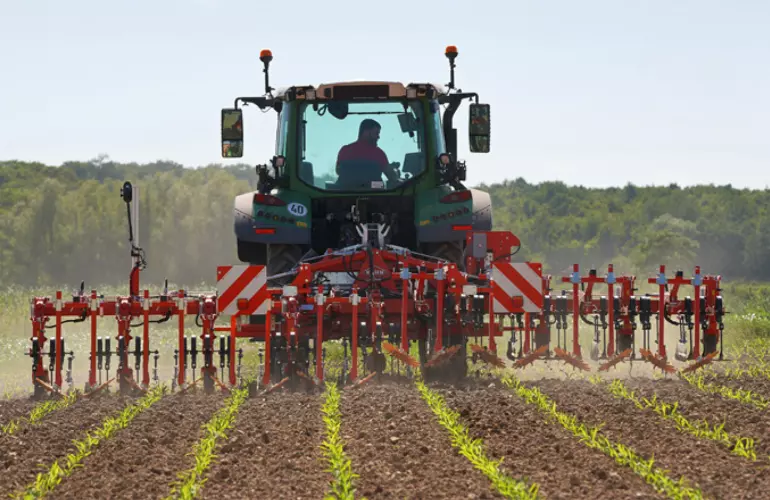
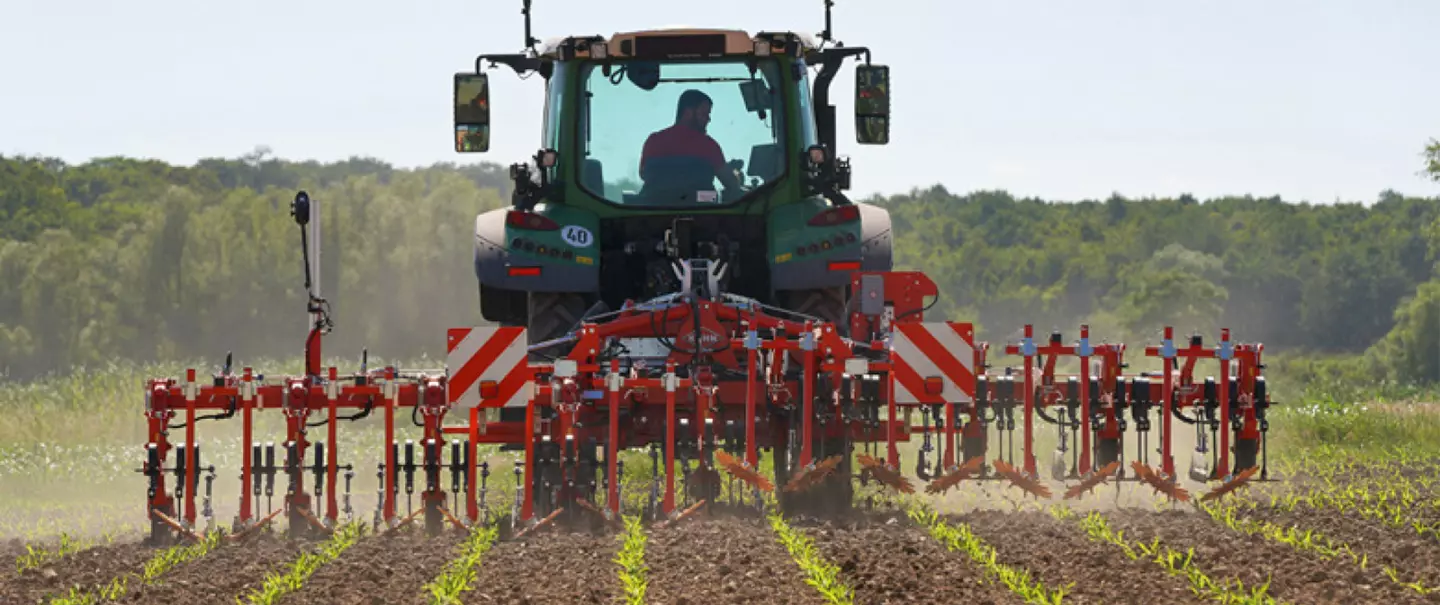
Row-crop cultivators are designed for weeding between widely-spaced row crops, such as maize, rapeseed, soya, beetroot, and sunflower (spacings from 45 cm to 80 cm). Unlike tine weeders and rotary hoes, row-crop cultivators can be used at late stages of growth.
Despite being more effective on young weeds, the beauty of row-crop cultivation is that it can manage more developed weeds. It has agronomic benefits too. Not only does it kill weeds, it also aerates and warms the soil, mineralises nutrients, and limits water evaporation. In optimal conditions, it works well against dicots and grasses. To avoid any misalignment when using this weeding method, the seed drill and row-crop cultivator should be the same width and set at the same spacing.
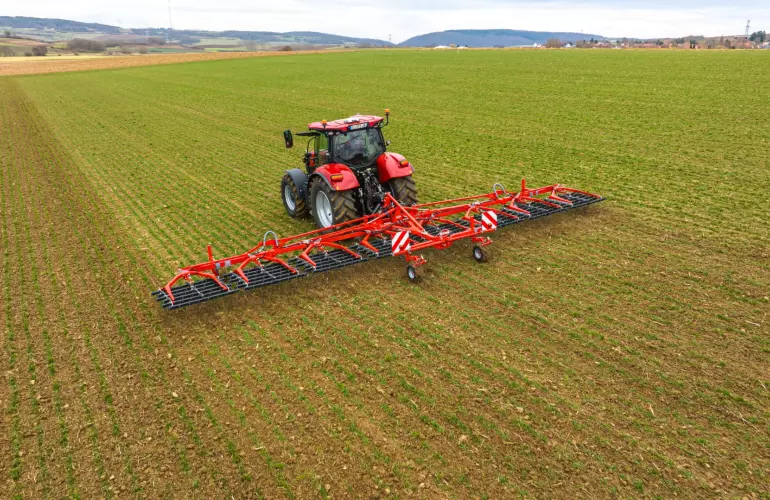
This tine weeder is equipped with flexible tines that pull up young weeds and leave them to dry out on the ground. It works the entire surface area of the plot (seed row and between rows), producing high output thanks to the machine’s large working width and speed.
In addition, it is versatile, so can be used from pre-emergence to more advanced stages of growth. It is effective on young weeds and works regardless of row spacing, which is not possible with a row-crop cultivator. It stimulates plant growth by improving soil mineralisation, water balance, and cereal tillering.
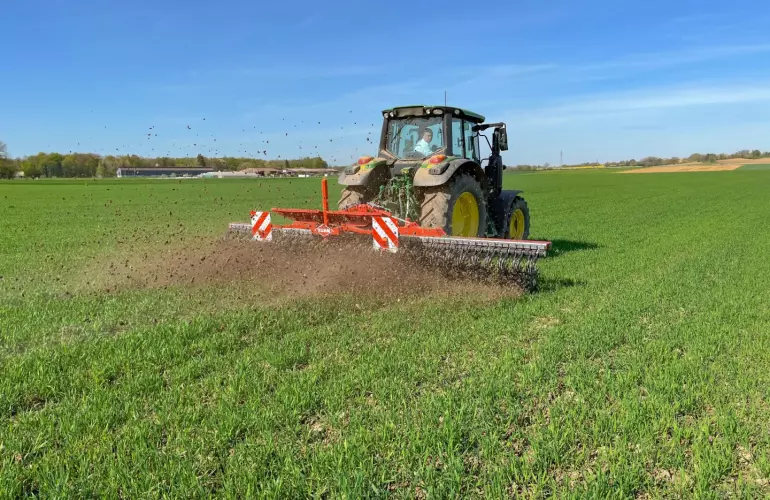
The STARLINER rotary hoe is a mechanical weeding machine that complements the work of the tine weeder. It is designed to crack open slaking crusts at high working speeds - over 12 kph. It crumbles the surface of the plot efficiently where the tine weeder shows its limitations and has a less aggressive weeding method which makes it possible to use it at earlier stages.
Like the tine weeder, the rotary hoe is a versatile machine. It can be used, irrespective of rows, to weed the whole surface area, or like a row-crop cultivator by removing certain components, so as not to damage the crop. It can also be used as a soil-preparation tool, to aerate the seedbed before sowing, or for stale seeding at a lower cost.
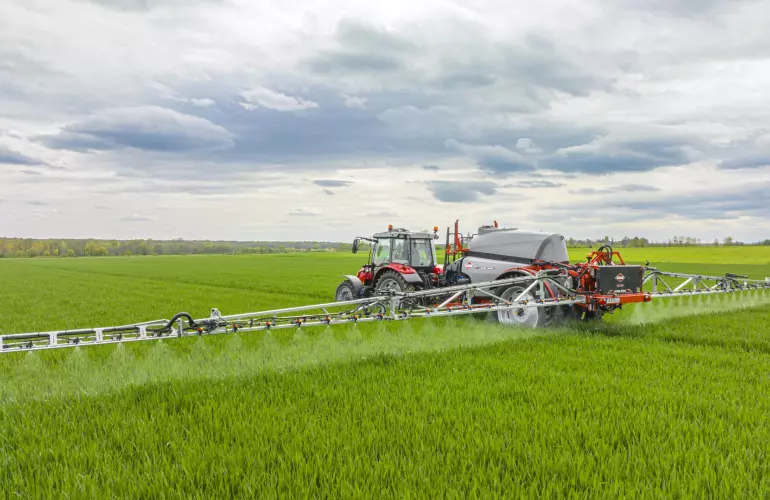
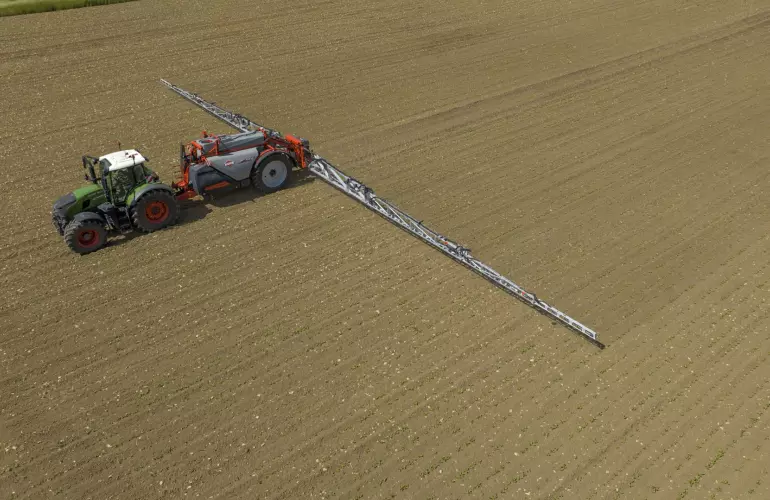
From mounted to self-propelled sprayers, there is a whole range of tools dedicated to protecting your crops
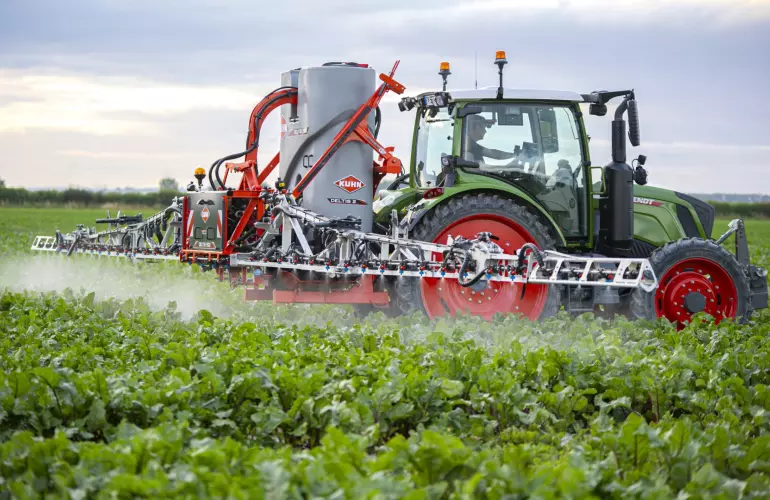
The DELTIS 2 sprayer is designed for small to medium farms. It is available in different tank sizes: 1,000, 1,300, or 1,500 L, and can be equipped with 15-to-24m steel or aluminium booms. A PF front tank can be added to increase autonomy.
KUHN has several trailed models of sprayer to offer adapted to different requirements:
LEXIS: a simple and compact machine that suits different farm types. It comes with 2,400-, 3,000-, and 3,800-L tank sizes and 18-to-28m booms in steel or aluminium. It is compact and stable, making road travel and field manoeuvres much easier.
KARAN: KUHN’s high-end sprayer is designed for medium and large farms as well as contractors. It is a high-performance tool thanks to 4,500- to 6,000-L capacities, booms up to 39 m, and working speeds up to 25 kph. It is practical to use with many automated functions available: EAGLE, the automatic ground following system, and DILUSET, the start-up system. KARAN also features advanced technologies for optimum crop protection, such as AUTOSPRAY, which controls droplet size and modulates application rates (TFI reduced).
Furthermore, certain patented innovations contribute to making KARAN a long-life tool: the pump-dismantling system in less than 5 minutes and maintenance on tank components without having to go inside.
Mechanical weeding is a method of eliminating weeds without using chemical products. There are several possibilities for mechanical weed control, so how do you choose between a row-crop cultivator, ti...
Adopt an integrated weed management or IWM strategy using chemical and mechanical methods to control weeds in field crops efficiently and sustainably....