A step change in cow health, feed consistency and a simple way to manage feed intake have been some of the major benefits since a Kuhn Profile diet mixer arrived at Culticheldoch Farm, near Muthill, Scotland, part of the Drummond Estate.
“You wouldn’t know there’re cows in the steading,” says farm foreman Stuart Thomson, “there’re so quiet and content and it’s a lot to do with providing them with the right food. It’s a huge justification for us that the Profile mixer wagon is doing exactly what we wanted it to do.”
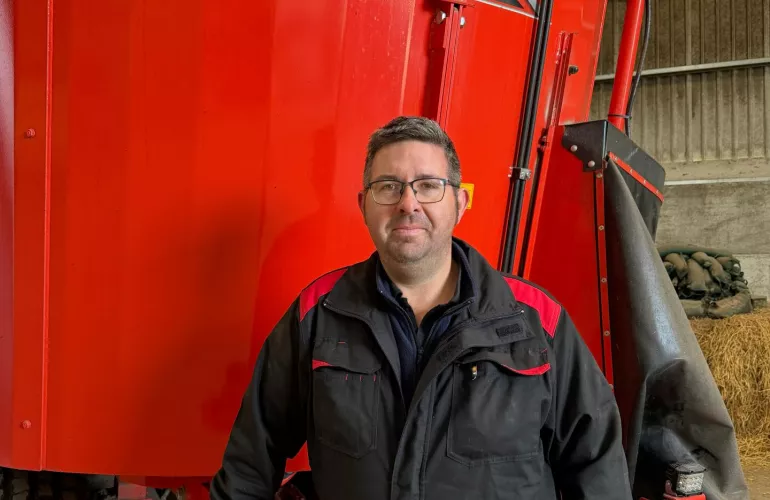
Prior to this, Stuart, farm manager, Fraser Campbell, along with a fulltime stockman and apprentice, were operating a solely baled silage system to fit in with the machinery on the farm. A single bale unroller and bale spike were the main tools for feeding the cows throughout the lengthy winter periods.
While this was passable with cow numbers at 50, the herd at Culticheldoch has now reached 200, along with 150 calves, and the old feeding and bedding operation was taking one person half a day. Valuable time that could be better spent on other tasks around the 800ha farm that includes 320ha of arable, along with silage ground and sheep grazing on a nearby glen.
The farm had to match any machinery purchases to the cow numbers to create an efficient system. “The herd has organically grown over the past eight years as new sheds have been erected. We finish all the bullock calves and keep all replacements to run a closed herd of Aberdeen Angus, Shorthorn and Simmentals, that we can now be very selective about the replacements we keep.”
Ration problems
The old feeding system left the team with little option for controlling ration intake, which was leading to health problems within the herd, as Stuart explains.
“As we could only control ration size on a per bale ratio, the larger cows would push to the front and bury their heads into the bale, resulting in silage eye, and needing treatment. If some cows looked like they needed more food, we could only increase this on a bale-by-bale ratio, which was very binary, and we couldn’t be sure how much they were eating.
“Cows will eat all day if you put tasty silage in front of them and we were risking issues with calves being too big, increased vet bills or stillborn calves. Controlling intake was essential to avoid this.”
After several demos, the farm chose a Kuhn Profile 25.2 CM, purchased through Agricar, which also coincided with the completion of an undercover clamped silage pit, moving away from a solely bale system. A key attribute of the mixer wagon during the demo was its ability to unload ration into the various Portaquip feeders around the yard, while also having a quick mixing time when fully loaded.
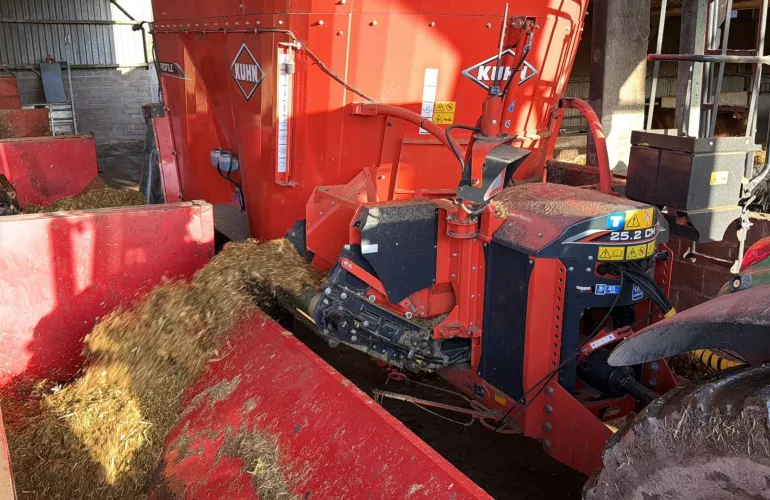
“Our bespoke cattle shed has a wide central feed passage that any machine can unload a ration in, but our challenge was the high sided portable feeders we use for the calves. Kuhn’s Flexlift conveyor design could reach into the 1.2m high troughs, allowing us to control the ration for all the animals on the farm. It was the only machine that could do this and was a key reason we chose the Profile.”
Mix consistency
Along with unloading ease, controlling the ration was essential. The first season with the Profile was using baled silage, which, with the optional counter knives engaged, helped to slow down the mixing process to provide a quicker and consistent chop.
When the calves are removed from their mothers, the ration is high in fibre to help transition away from a milk-based diet and minimise digestive upset. Stuart says the team constantly monitor the herd and adjust the ration, based on their progress, how dirty the pens are, and ensuring the feed troughs and passages have some food overnight. The ration recipes are prestored in the DG 600 weighing system, allowing users to tweak ingredients on the go and adjust recipes where required.
“At the start we may start with 1.5kg of straw but this will reduce to 0.5kg by the end of the winter, with barley and silage increased to provide more nutrition to the animals and less roughage. Straw is added first with the counter knives in to achieve a consistent chop before silage, maize, and then our premix and liquids last.
“The system is so easy to adjust before you start loading. If we wanted to add more straw or increase silage quantities per cow, we just adjust this in the DG 600. Herd size can also be changed, for example, if we’ve put 10 cows out to grass the previous day, we alter this number in the screen, and the ingredient quantities will automatically adjust to the new herd size.
“Since the mixer wagon has arrived, every calf is getting the same opportunity to eat the same mouthful of silage, as the mix quality and feeding into troughs or feed passages has allowed this.”
Stuart says this is the control they didn’t have before and has really helped to save inputs, with no wastage, and crucially not over or under feeding the cows. Mix time for a full 5t load is around 15-20 minutes, and the consistency is the same whether its 1t or 5t in the Profile.
“We can load the mixer, then bed the cows we’re about to feed using our Kuhn Primor 3570 straw blower, in the time it takes for the mixer to complete its cycle. The system is now very efficient and the Primor has also shortened bedding cycle times.”
More options
Although there’s now two bays of clamped silage, one for cows and the other for calves, some bales are still produced for several reasons.
“We use bales for buffer feeding and clearing up some fields that have run away from the cows. We’re also looking at baling some of the red clover mix, as this goes into the clamp first, and we then don’t have access to it until later in the winter. By baling some of it, we can add it to the mix early in the winter to boost proteins and sugars.”
Several options were added to the Profile during the build, including a rear door as a preventative measure in case the Flexlift conveyor ever failed. However, the door has proved useful for other tasks as well, including pre-mixing.
“Our premix consists of 5t of rolled barley, 1t of pellets and five bags of minerals. We can load the Profile with this and mix for a short period before opening the rear door and driving slowly forward in the bay to unload.”
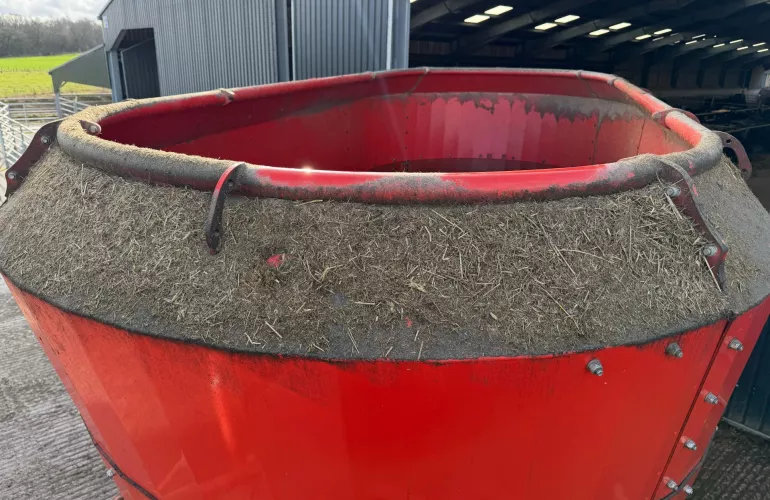
As standard, Kuhn designs the mixer tubs with an integral hay ring, which is sloped to avoid material sitting on top of the tub, becoming old, and then potentially falling into the mix several days or weeks later.
Stuart concludes by saying the mixer has become a victim of its own success. “It’s offered us lots of new options and we now keep some of the calves in during the summer if they require a more specific ration than just grass. The mixer isn’t hard to run, and the accuracy means we can control inputs to our herds’ requirements.”