
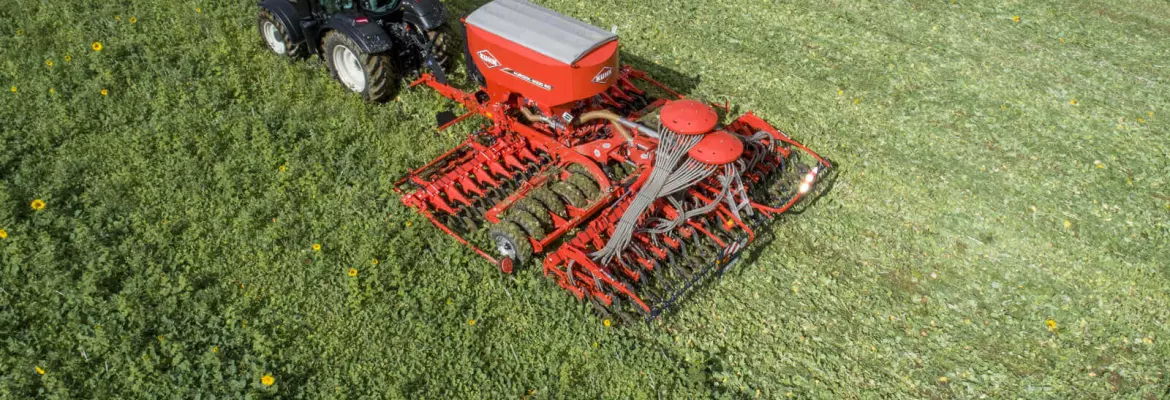
Direct drilling is a technique that is used on more than 50 million hectares of agricultural land around the world. As part of conservation agriculture, it was originally developed in response to erosion problems. Using a direct drilling seed drill and associated crop-management method has many advantages: savings on equipment, labour, and fuel, as well as beneficial effects on the soil and its structure, as well as on wildlife. An overview of the reasons behind its success.
Opting for direct drilling to reduce mechanisation costs, labour, and fuel
Farm mechanisation costs are €150 to €400/ha and per year. With direct drilling, it is between €150 and €250/ha, with profits that increase over time. Direct drilling requires less material and causes less wear to farm equipment. Even after depreciation, machines can continue to be used on the farm. The lower costs are due to a lower traction-power requirement.
By reducing tillage, labour costs are up to 3.75 times lower than with a ploughing method, and 3 times lower than with min-till (minimum cultivation techniques).
Also worth knowing before you start: direct drilling under plant cover uses less fuel. It uses 26 litres less fuel per hectare than conventional ploughing and 11 litres less per hectare than min-till.
Agronomics: the advantages of direct drilling on in terms of water and the soil
Soil cover makes water infiltration possible. It also limits evapotranspiration, run-off and nitrate leaching. Increasing organic matter in the soil increases its water storage capacity. Root development through the soil’s layers under the seeding row ensures more efficient water uptake and retention.
Keeping plant cover and/or crop residues on the surface reduces problems of erosion. Lastly, there is a higher carbon content in the topsoil and shallow layers (0-15 cm). The soil is more fertile with more biological activity (earthworms and micro-organisms). There is less soil compaction.
The effects of using a direct drilling seed drill on productivity and inputs
Higher productivity is directly linked to the reduced work time involved in direct drilling methods. An average of 2 hours 15 minutes per hectare and per year is spent on the field with the direct drilling method. Min-till is nearly double that. If low-volume spraying is carried out, the hourly volume reaches 1 hour 30 minutes!
Transitioning to a direct drilling farming technique can increase operational costs the first few years. The savings come later, by carefully choosing less-demanding crops for the rotations and producing nitrogen by including legumes in the rotation. Weeds can be managed, in direct drilling techniques, with products like glyphosate.
However, with experience, using fast-covering, frost-sensitive plants that can be destroyed by a roller or crop cutter, can reduce the need for such products, especially as after some years of direct drilling, weed seeds and stock tend to decrease.
Sources:
- https://agriculture-de-conservation.com/TCS-et-semis-direct-quelles-sont.html
- https://www.perspectives-agricoles.com/sites/default/files/imported_files/390_178500165713742149.pdf
- https://agriculture-de-conservation.com/sites/agriculture-de-conservation.com/IMG/pdf/TCS36_semis_direct_economie.pdf